What this 16-bit DAC brings to the rail
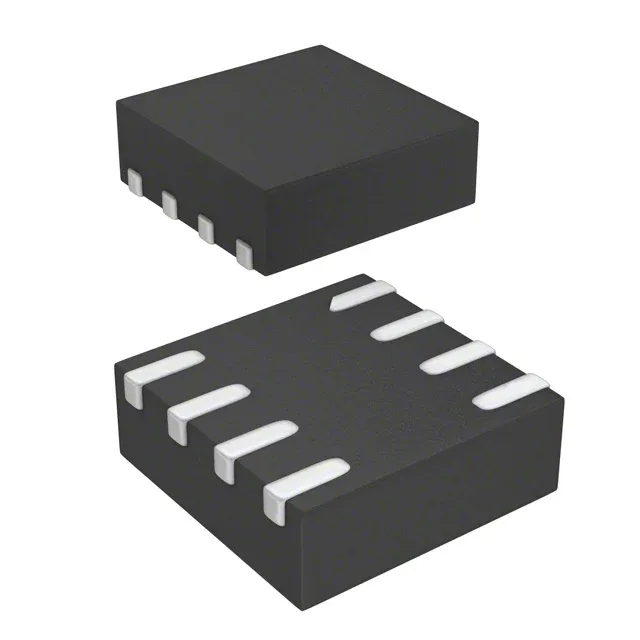
The Texas Instruments DAC80501MDQFT is a single-channel, 16-bit voltage-output digital-to-analog converter built around an R-2R ladder architecture. It delivers a buffered voltage output with a typical settling time of 5µs, making it a fit for precision control loops, waveform generation, and programmable voltage references where the output needs to land fast and stay accurate. The digital interface supports both I2C and SPI, so it can drop into existing bus architectures without a protocol translator. That temperature grade, combined with the 2x2 mm 8-WSON package, means this part can live on a compact board near a hot processor or motor driver without derating concerns.
The 5µs typical settling time to ±0.5 LSB means the output voltage reaches its final value within one 200 kHz update cycle. INL and DNL are both specified at ±1 LSB maximum. That guarantees monotonicity — the output always increases when the digital code increments — which matters for servo positioning and ramp generation where a non-monotonic step would cause a control reversal. The ±1 LSB DNL also means no missing codes at 16-bit resolution.
Supply and interface: one rail, two buses
With a single 2.7V to 5.5V supply covering both analog and digital domains, the DAC80501MDQFT runs cleanly off a 3.3V or 5V rail. No separate analog regulator needed unless the system's digital rail is noisy — in that case, a ferrite bead and 1 µF cap on the AVDD pin is the usual fix. The I2C and SPI interfaces share the same pins, selected by the state of a dedicated pin at power-up. SPI mode supports clock rates up to 50 MHz (typical), while I2C runs at standard/fast mode up to 400 kHz.