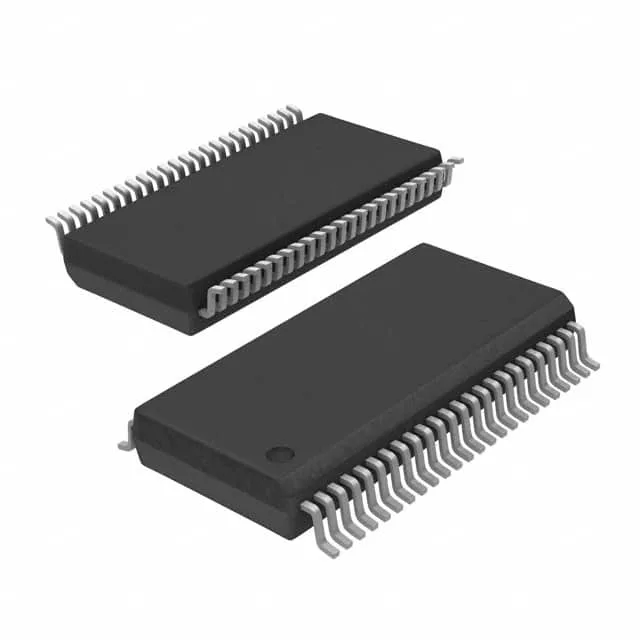
74FCT bus buffer — 16-bit non-inverting with 3-state outputs
Each output can sink or source 24 mA, which is enough to drive a heavily loaded parallel bus or a bank of address/control lines on a memory module.
It is ROHS3 compliant and lead-free per the manufacturer's declaration, so it passes the RoHS exemption check for new designs shipping into EU and California markets. The date-code laser etch on the package should trace cleanly through the authorized chain — no re-mark or sanding risk if you buy from a qualified distributor.
The symmetric 24 mA sink and source rating is the headline specification for this buffer. At 5.0 V nominal, that drive strength can charge and discharge the capacitive load of a 16-bit address or data bus running at 50–100 MHz without excessive edge-rate degradation. The 3-state outputs let multiple buffers share the same bus lines — common in memory-multiplexed or peripheral-shared architectures where the bus needs to float when not driven. Because the 74FCT family is designed for low ground bounce and controlled output-edge rates, you get cleaner signal integrity on the backplane than with older 74F or 74ALS parts. The trade-off is that the 24 mA drive is fixed — there is no programmable slew-rate control, so the PCB layout needs to keep trace lengths short and stub-free to avoid ringing on unterminated lines.
Package and mounting — 48-BSSOP footprint
The 48-BSSOP package (also referred to as 48-SSOP in the supplier device code) has a 7.50 mm body width and 0.635 mm lead pitch. It is a surface-mount package intended for reflow soldering. The fine pitch means the PCB land pattern must be precise — a 0.3 mm stencil aperture for the paste is typical to avoid bridging.