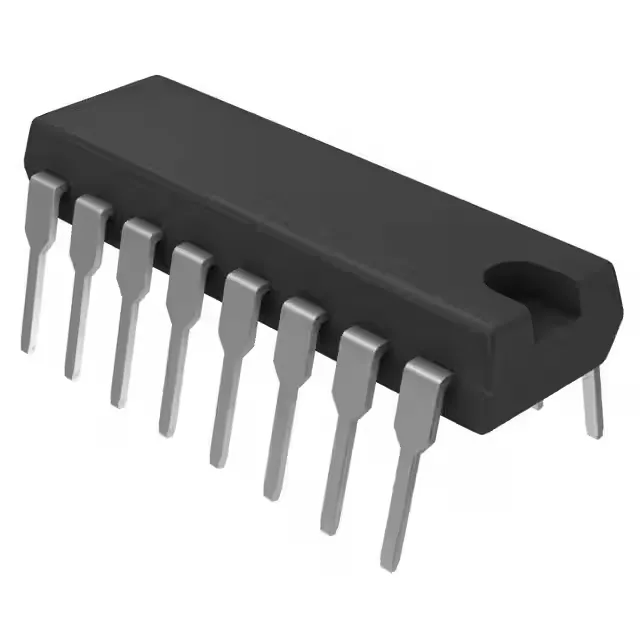
The Texas Instruments CD74HCT174E is a 74HCT-series hex D-type flip-flop with a common master-reset function. It integrates six positive-edge-triggered flip-flops in a single 16-pin DIP package, with non-inverted outputs on each channel. The part operates from a 4.5 V to 5.5 V supply and is specified over the full military temperature range of -55°C to 125°C, making it suitable for avionics, satellite, downhole drilling, and other harsh-environment control logic where the board sees wide thermal swings. The 25 MHz maximum clock frequency supports moderate-speed synchronous bus interfacing, while the 4 mA source/sink output drive handles standard TTL/CMOS fan-out and small loads like indicator LEDs or relay coil drivers.
Through-hole 16-DIP package — legacy footprint, repair-friendly
The 16-DIP (0.300", 7.62 mm) through-hole package is a legacy format still widely used in industrial control boards, test equipment, and prototyping. It is socket-friendly, easy to hand-solder, and simpler to inspect than a fine-pitch SMD. For a repair depot or MRO environment where boards are reworked with a soldering iron, the DIP package is a practical choice. The supplier device package is 16-PDIP.
Master reset function and positive-edge triggering
The common master reset (MR) input, active low, clears all six flip-flops asynchronously when asserted. This is useful for power-on reset or emergency clear in a state machine. The positive-edge trigger on the clock input means data is captured on the rising edge — standard for most synchronous logic families. The non-inverted outputs drive the same polarity as the input.
The laser etch on the package should trace cleanly to Texas Instruments' date-code format — we recommend verifying the top-mark font and lot code against TI's marking specification, especially for gray-market stock.