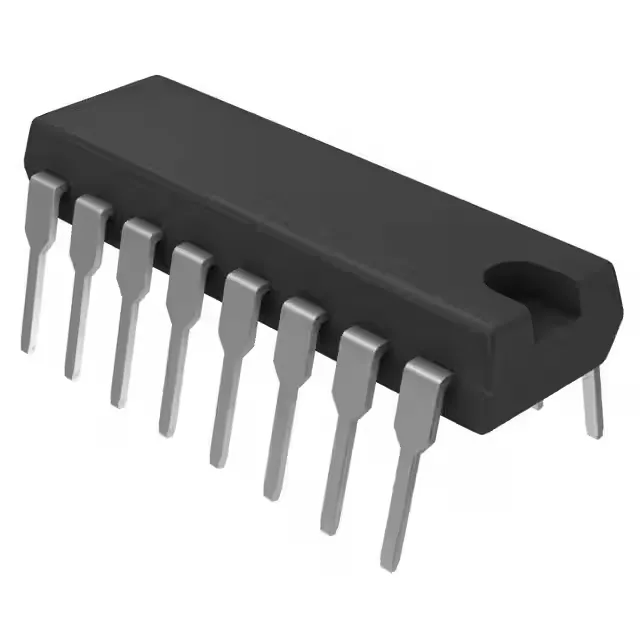
It selects one of eight data sources (D0 through D7) based on a 3-bit binary address (A, B, C) and presents it at the Y output, with a complementary W output available. The 1 x 8:1 circuit means one multiplexer per package, no independent sub-circuits to manage. The 16-DIP through-hole package (0.300" body width, 7.62mm lead spacing) is the legacy dual-inline format that sockets well and survives rework cycles.
Supply voltage and temperature — the real selection gate
The 2V to 6V supply range is wider than the 74LS family (typically 4.75V to 5.25V) and matches the 74HC standard. At 2V the propagation delay increases, but the part still switches — useful for battery-operated gear running down to 2V before the regulator drops out. At 6V you get the full speed and drive capability, but the CMOS inputs are 5V-tolerant at that rail; no level shifting needed when mixing 3.3V and 5V domains as long as the VIH/VIL thresholds are respected. If your BOM calls out a part for a sealed outdoor telecom cabinet, a military vehicle, or a satellite payload, this temperature grade alone justifies the selection. The 74HC process holds logic states across that span, but the propagation delay roughly doubles from 25°C to 125°C — budget timing margin accordingly if the data path runs near the maximum frequency.
Package and mounting — through-hole for socketed or rework-heavy builds
The 16-DIP (0.300" body, 7.62mm lead pitch) is a through-hole package that inserts into a standard 0.1" grid breadboard, a DIP socket, or solders directly into plated through-holes. The through-hole format is preferred in high-reliability or high-vibration environments where a socketed IC is easier to replace than a reworked SMD part, and it survives hand-soldering and rework cycles that would stress a fine-pitch SOIC. No exposed pad, no thermal vias needed — the package dissipates through the leads and the body.
The ROHS3 compliance (lead-free, no exemptions) covers EU and global regulatory requirements for current builds. Because the part is active and widely used, it is stocked across multiple independent distribution channels.