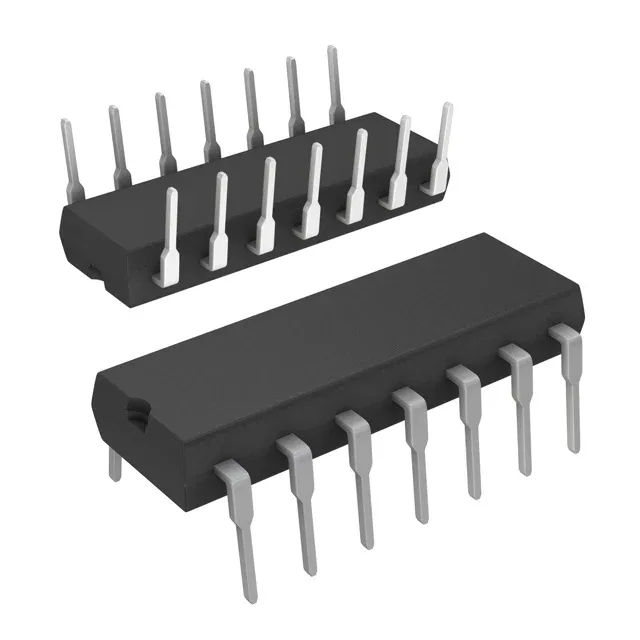
Texas Instruments CD74HC107E — Analog & Data Acquisition

CD74HC107E JK Flip-Flop, 60 MHz, 2V-6V, 14-DIP

MPNCD74HC107E
End of Life

Texas Instruments 74HC series, CD74HC107E, IC FF JK Type Dual 1-Bit, 60 MHz, 2V-6V, Negative Edge Trigger, Complementary Output, Through Hole 14-DIP (0.300", 7.62mm), -55°C to 125°C.

$0.98Ref. price · indicative, final on quote
Packaging14-DIP (0.300", 7.62mm)
StockContact for availability
MOQ1 pcs
  • 100% new & originalTraceable channels only — no refurbs, no pulls, no remarked parts.
  • Date & lot codes on quoteStated per line before you commit; label photos on request.
  • MSL-compliant ESD packingMoisture-sealed bags with indicator cards; reels photo-verified.
  • PayPal buyer protectionPay by T/T, PayPal or Payoneer — card payments covered end to end.

Specifications

CD74HC107E Technical Specifications
ParameterValue
TypeJK Type
Series74HC
Output typeComplementary
Trigger typeNegative Edge
Mounting typeThrough Hole
Voltage2V ~ 6V
Current - quiescent4 µA
Current - output high, low5.2mA, 5.2mA
Frequency60 MHz
Operating temperature-55°C ~ 125°C (TA)
PackageTube
FunctionReset
Case14-DIP (0.300\", 7.62mm)
Input capacitance10 pF
Number of elements2
Number of bits per element1
Max propagation delay @ v, max CL29ns @ 6V, 50pF

Product details

Dual JK flip-flop with reset — 60 MHz, 2 V to 6 V, through-hole DIP-14

The Texas Instruments CD74HC107E is a dual JK flip-flop in the 74HC logic family. Each of the two elements stores one bit, triggered on the negative edge of the clock, with complementary outputs (Q and /Q) and an active-low reset input. It runs from a 2 V to 6 V supply and clocks at 60 MHz, making it a straightforward choice for counter, divider, and register applications in 5 V and 3.3 V systems that need a clean edge-triggered storage element.

60 MHz clock and 29 ns propagation delay — timing margin for the bus

The 60 MHz maximum clock frequency and 29 ns max propagation delay at 6 V, 50 pF load set the timing budget. At 5 V operation the delay is slightly longer than the 6 V figure — typical for HC logic — so the 29 ns number is the cleanest corner. For a 10 MHz system clock, the delay leaves plenty of margin; at 30 MHz the designer should check setup/hold against the driving device's output timing. The negative-edge trigger means the flip-flop captures data on the falling clock edge, which can simplify clock-domain crossings if the preceding stage outputs on the rising edge.

Military temperature range and 4 µA quiescent current

Rated -55°C to 125°C, the CD74HC107E covers military and industrial environments — avionics, downhole, outdoor telecom, engine bay — where commercial-grade logic would drift or fail. Quiescent current is just 4 µA, so in a battery-backed or always-on subsystem the static draw is negligible. Output drive is 5.2 mA source and sink, typical for HC logic; it can drive a few LS TTL inputs or a CMOS load directly, but for a heavy fan-out or a long trace a buffer is advisable.

Through-hole DIP-14 — prototyping and legacy socket compatibility

The CD74HC107E comes in a 14-pin DIP (0.300" body, 7.62 mm pitch) with a 14-PDIP supplier package. This is the classic through-hole footprint that fits breadboards, prototyping boards, and existing socketed designs. For new builds with surface-mount assembly, look at the SOIC-14 variant of the same function. Input capacitance is 10 pF, which is standard for HC logic and won't load a typical CMOS or TTL output significantly.

Active lifecycle — no EOL risk for production

Texas Instruments lists the CD74HC107E as Active with ROHS3 compliance. There is no last-time-buy notice or obsolescence flag. For volume or scheduled orders, the supply posture is stable — no need to qualify a second source unless dual-sourcing policy requires one.

Frequently asked questions

Can the CD74HC107E be used in a 5V system?

Yes. The supply range is 2 V to 6 V, so 5 V is well within the operating window. At 5 V the propagation delay will be slightly longer than the 29 ns figure quoted at 6 V, but still well under 40 ns — fine for most 5 V logic systems up to 20-30 MHz.