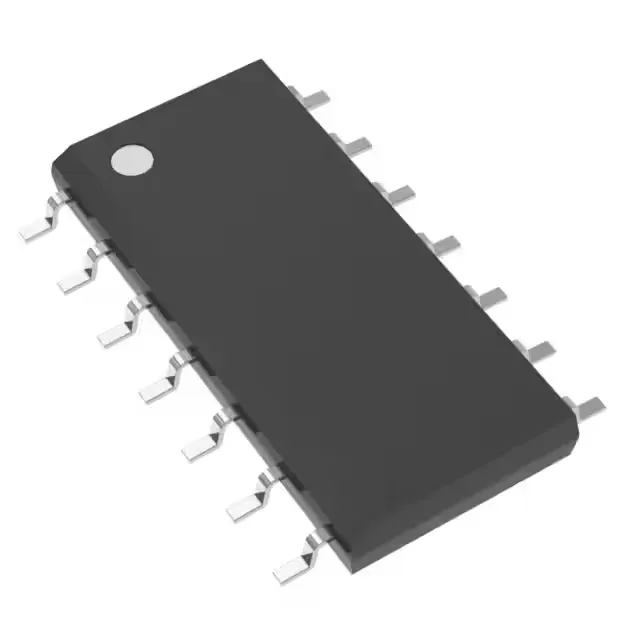
Quad 2-input NAND gate in the 74HC family
It integrates four independent NAND gates on a single die in a 14-SOIC package, each with two inputs.
If your system already uses 74HC logic elsewhere, this part thermally matches the rest of the family.
The max propagation delay is 15 ns at 6V supply with a 50 pF load. In a 5V system, expect a few nanoseconds slower, but still comfortably below 20 ns for most board-level glue logic. That is fast enough for address decoding, clock gating, or control signal cleanup running at 50 MHz or slower. If your bus cycles at 100 MHz or above, you will want a 74AHC or 74LVC variant with sub-10 ns delay.
Output drive and quiescent current
That is enough to drive one or two CMOS loads directly, but not a long trace or a high-capacitance bus — add a buffer if you need to fan out to more than three gates. The quiescent current maxes at 2 µA per package, so the whole IC draws negligible power when idle, which matters for battery-powered or always-on subsystems.
The 74HC family is a mature, widely second-sourced logic family, so supply risk is low.