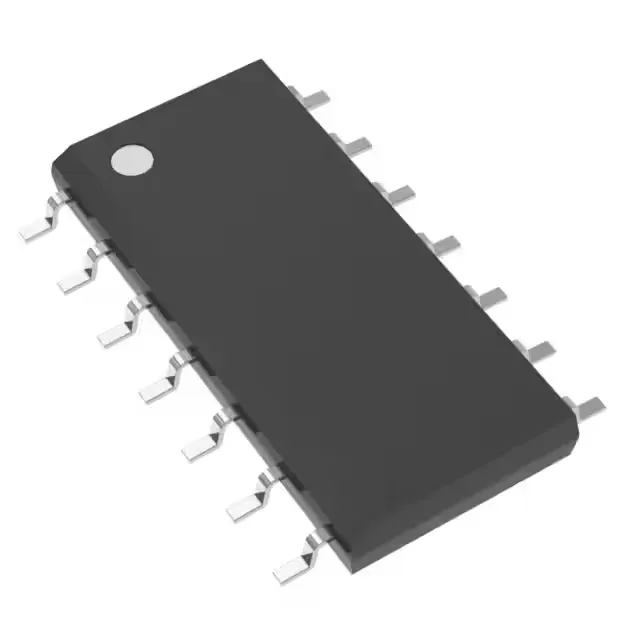
What this 4000B NAND gate brings to a board
Supply range and temperature — where this part survives
The 3V to 18V supply range is the headline differentiator. A 74HCT part like the CD74HCT132M96 locks you into 4.5V to 5.5V; the SN74AHC1G00DBVT stretches from 2V to 5.5V. The CD4012BM96 runs happily at 3V from a lithium cell or at 15V in an industrial 24V system with a regulator. If your board sees cold-soak on a runway or heat soak under a hood, this part handles it without derating.
Propagation delay and drive — the speed tradeoff
The 90ns max propagation delay at 15V with a 50pF load is slow compared to 74-series logic. The CD74HCT132M96, for example, clocks 33ns at 4.5V. That matters when you're gating a clock or qualifying a data strobe — the 4000B family is for control signals and status flags where tens of nanoseconds don't break timing, not for high-speed datapaths. Output drive is 3.4mA source and sink, enough to light an LED or drive one CMOS load but not a long bus trace.
Package and footprint — what you're soldering
Surface-mount only — there is no DIP variant of this exact order code. If your repair bench needs a through-hole part, you're looking at the CD4012BE or CD4012BCN, which are different order codes in PDIP-14.
Texas Instruments lists it as ROHS3 compliant. For a 4000B-series part that's been around for decades, that's a solid sign the fab line is still running. No successor part is listed because none is needed. If you're filling a BOM line for a long-life product, this part has no LTB risk and no forced redesign coming.