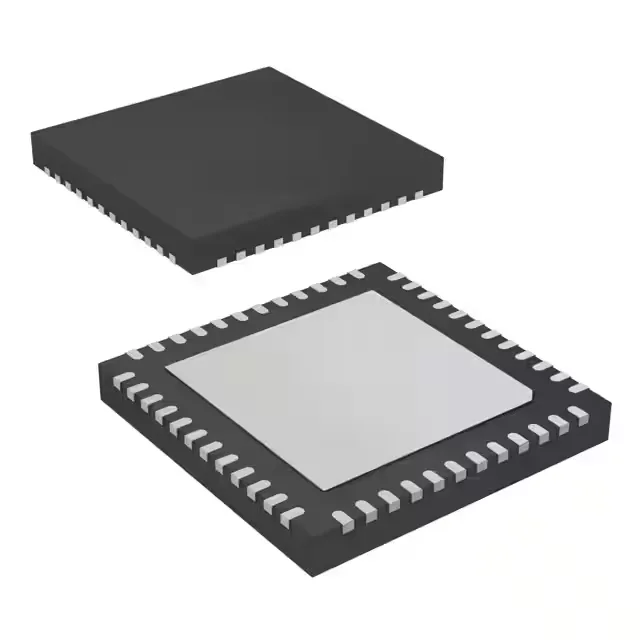
Bluetooth 5.0 wireless MCU with integrated transceiver
The Texas Instruments CC2640R2FRGZR is a Bluetooth v5.0-qualified wireless MCU from the SimpleLink™ family, combining a 2.4GHz transceiver with an ARM Cortex-M3 core. It carries 128kB of Flash and 20kB of RAM, enough for a BLE application stack plus a sensor profile or control loop. The receiver hits -97dBm sensitivity, and the transmitter delivers up to 5dBm output power — a combination that gives a clean link budget for indoor IoT nodes, wearable peripherals, and industrial sensor tags. Thirty-one GPIO lines bring out I²C, I²S, SPI, and UART interfaces, so the part can talk to external sensors, codecs, or displays without a separate host MCU.
The 48-VFQFN with exposed pad (7x7 mm footprint) provides a low-inductance ground path for the RF section and helps pull heat away from the PA during continuous transmission.
For BOM planning, the base product number CC2640 covers multiple Flash and RAM density variants in the same 48-VQFN footprint, giving a drop-in migration path if a future firmware revision needs more memory.
Current draw and battery-life planning
Receiving current is 5.9mA and transmitting current is 9.1mA at the 5dBm output setting. The 20kB RAM is enough to hold connection state and a small sensor buffer during standby, keeping the active current draw short. If the design needs longer range at the cost of battery life, the 5dBm output can be reduced via software to a lower power level to save current.
Programming and debugging interface
The CC2640R2FRGZR is programmed through the standard ARM Serial Wire Debug (SWD) interface, accessible on dedicated pins. TI provides a royalty-free BLE-Stack SDK that includes the Bluetooth 5.0 protocol stack, sample applications, and a flash programmer utility. No external programmer is required beyond a standard JTAG/SWD debug probe such as the XDS110 or J-Link. The 128kB Flash holds both the application code and the stack image, so the firmware update process uses an internal bootloader that can receive new images over the air or through the UART.