128 kB Flash and 28 kB SRAM — firmware headroom for BLE stacks
The 128 kB Flash and 28 kB SRAM accommodate the Bluetooth v4.1 protocol stack plus a moderate application payload. For a sensor node running the BLE stack and a small application loop, this memory budget is typical. If the design requires over-the-air firmware updates or a larger application image, the 128 kB Flash may be tight — plan the memory map early.
Bluetooth v4.1 — not Bluetooth 5 compatible
This part implements Bluetooth v4.1, which means it does not support Bluetooth 5 features such as 2 Mbps PHY, extended advertising, or LE Audio. For BLE 4.1 applications (beacons, remote sensors, HID devices), this part is well matched.
-97 dBm sensitivity and 5 dBm TX power — link budget for range
Receiver sensitivity of -97 dBm and a maximum transmit power of 5 dBm give a link budget around 102 dB in free space, which translates to roughly 100–200 meters line-of-sight depending on antenna and environment. For indoor applications through walls, expect 20–40 meters. The 1 Mbps data rate is the standard BLE 4.1 rate.
15 GPIOs and serial interfaces
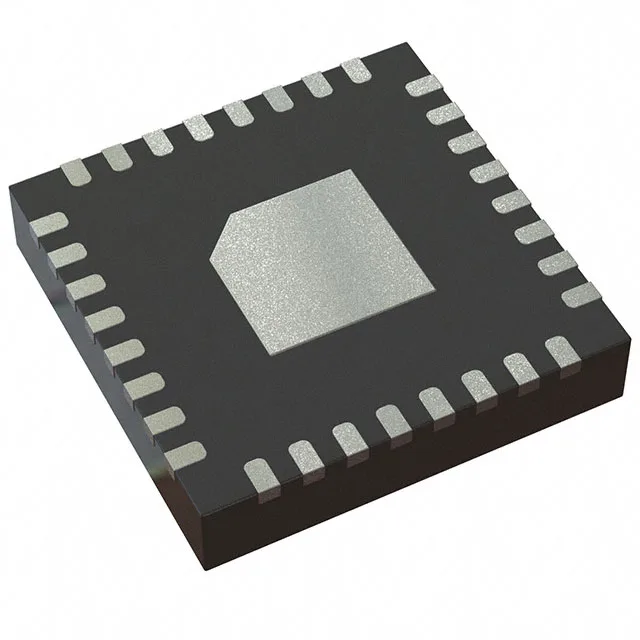
Fifteen GPIOs are available on the 32-VQFN package. The serial interface set includes I2C, I2S, JTAG, SPI, and UART, which covers most sensor and actuator peripherals. The JTAG interface is the primary debug and programming port; TI's CC13xx/CC26xx SDK and a compatible debug probe (e.g., XDS110 or LAUNCHXL-CC2640R2) are used for development.