8.128 A max charge current — sizing the power stage
The BQ25708RSNT is a multi-chemistry battery charger IC from Texas Instruments that handles 1 to 4 series cells with a constant-current charge profile. The headline rating is the 8.128 A maximum charge current — that figure drives the inductor saturation current rating and the external MOSFET Rds(on) budget. A 10 µH inductor with a 10 A saturation rating and low-side FETs with sub-10 mOhm Rds(on) keep the power stage losses under control at full tilt.
SMBus control — not a standalone charger
This part communicates over an SMBus interface — the charge voltage, current limit, and input current limit are set through the bus, not by resistor dividers. That means the host microcontroller must have an SMBus port and firmware to initialise the charger on power-up. Without bus traffic the charger sits in its default or shutdown state, so a design that expects plug-and-play standalone operation needs a different part.
19.2 V battery pack — cell chemistry and count
The maximum battery pack voltage is 19.2 V. For Li-ion that maps to a 4-series stack (4S, 16.8 V full), for LiFePO4 it covers a 5-series stack (5S, 18.25 V full). The 24 V maximum supply input gives headroom for a common 19 V laptop adapter or a 24 V industrial rail. The 1-4 cell range also covers single-cell portable gear up to 4S power-tool packs.
32-QFN package — rework and thermal reality
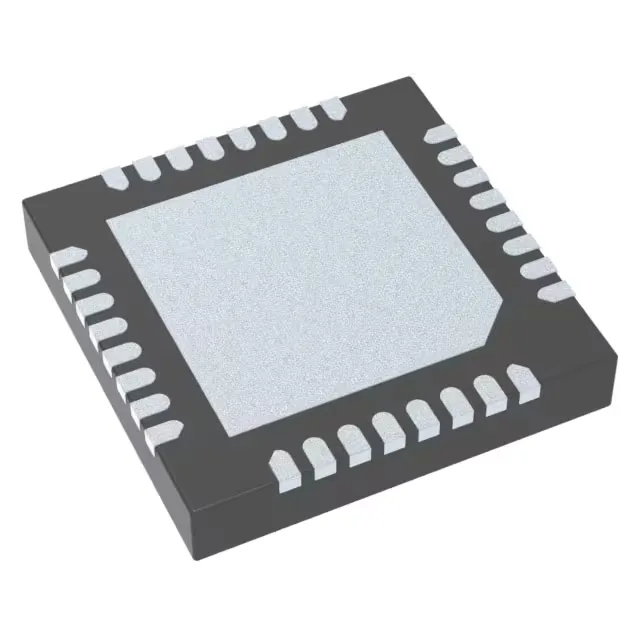
The 32-WFQFN with exposed pad (4x4 mm) is a compact package that demands a controlled hot-air profile for rework. Without adequate copper area the junction temperature climbs above the 155 °C absolute maximum under sustained 8 A charge current.
Built-in fault protections — fewer external parts
Over-temperature, over-voltage, and short-circuit protection are integrated. The -40 °C to 155 °C junction temperature range covers automotive under-hood and industrial motor-drive environments where the die sees high ambient plus self-heating from the power stage.