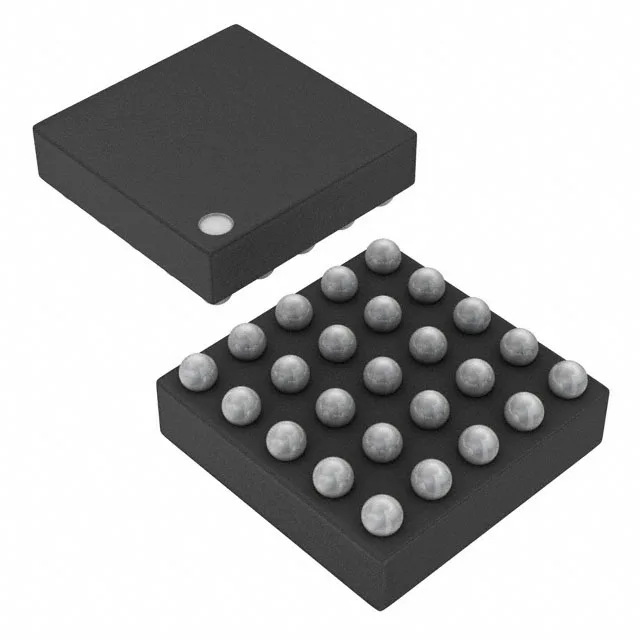
Single-cell Li-ion charger in a 25-bump DSBGA
It integrates I²C programmability for both charge current and battery regulation voltage, so you can tune the charge profile in firmware rather than swapping sense resistors. The 25-bump DSBGA package (0.4 mm pitch) keeps the footprint tight — about 2.1 mm × 2.1 mm — suited for wearable, IoT sensor, and portable medical devices where board area is at a premium.
300 mA charge ceiling and 4.65 V pack limit
The 300 mA maximum charge current sets this part for small-capacity cells — think 100 mAh to 500 mAh Li-ion pouches common in hearables and coin-cell replacements. The battery pack voltage tops out at 4.65 V, which covers standard 4.2 V and 4.35 V Li-ion termination voltages with margin. Input supply maximum is 5.5 V; a typical 5 V USB rail or regulated 5 V bus works without a front-end LDO, though the linear topology means thermal dissipation at full current needs a layout that moves heat through the DSBGA bumps to the PCB copper. Built-in fault protection covers over-temperature, over-voltage, and short-circuit conditions. That reduces the external component count — no separate supervisor IC for the charge path. The I²C interface lets a host MCU read fault flags and adjust charge parameters on the fly, which is useful for multi-chemistry or multi-format battery bays.
25-DSBGA: layout gotchas
The 25-bump DSBGA uses a 0.4 mm ball pitch — standard for fine-pitch BGA assembly but requires a solder-mask-defined pad on the PCB. No exposed thermal pad — all heat exits through the bump array into the PCB copper.