Maximum charge current is 1.25 A — enough for a typical 1000–1500 mAh cell to charge in about an hour, but the I²C bus lets the system throttle current down for thermal management or trickle charging a deeply discharged cell. The chip integrates over-temperature and over-voltage fault protection, so the BOM does not need a separate supervisor for those conditions.
What the 1.25 A charge current and I²C control mean for your BOM
At 1.25 A the pass element dissipates (Vin – Vbat) × 1.25 A as heat. With a 5 V input and a 3.7 V cell, that is about 1.6 W — the DSBGA package relies on the PCB copper for thermal spreading, so a 2-layer board with a solid ground plane under the IC is recommended. The I²C interface (address 0x6B) gives the host full control over the charge current in programmable steps, plus read-back of fault and status bits. No external resistor divider is needed for current setting — the firmware sets it. Battery pack voltage is limited to 4.44 V max, which covers the standard 4.2 V and 4.35 V Li-Ion/Polymer termination voltages with margin.
Package and layout considerations for the DSBGA
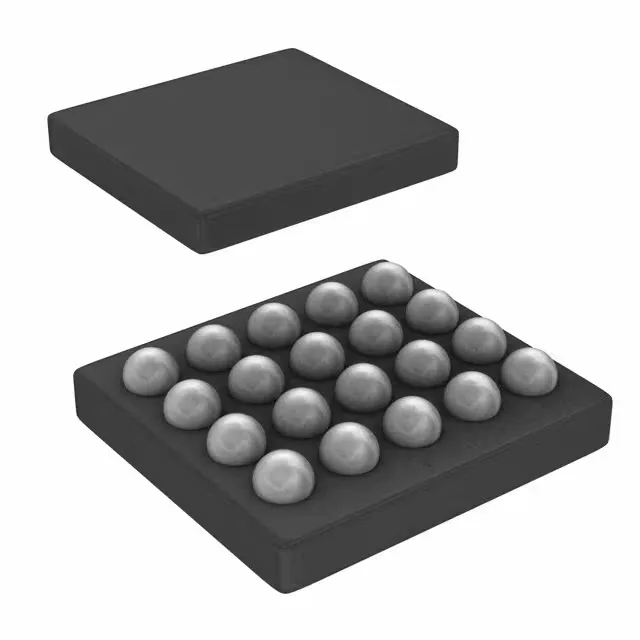
The 20-DSBGA package (0.5 mm pitch, 0.25 mm ball diameter) requires a solder-mask-defined pad and a stencil aperture that matches the datasheet land pattern. Reflow profile must follow the JEDEC MSL-1 moisture sensitivity — no bake needed if the shelf life is respected. Surface-mount only — the DSBGA is not hand-solderable; a hot-air rework station with a fine nozzle and a preheat plate is the minimum for rework.