Precision measurement ADC with on-chip PGA
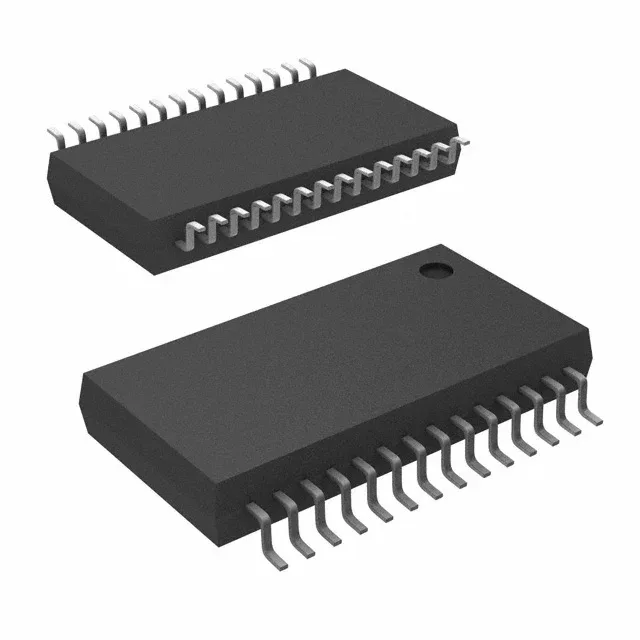
The Texas Instruments ADS1256IDBRG4 is a 24-bit sigma-delta ADC designed for precision measurement applications that demand low noise and high resolution. Its architecture combines a multiplexer, a programmable gain amplifier (PGA), and the ADC core in a single 28-SSOP package, making it a fit for weigh scales, strain-gauge transducers, pressure sensors, and industrial process control loops where the signal amplitude varies across channels.
30 kSPS data rate — what it buys you
The 30 kSPS maximum sampling rate sets the upper bound for per-channel throughput. In a multiplexed system scanning all 8 single-ended inputs, each channel sees roughly 3.75 kSPS — fast enough for DC or slowly varying signals like temperature, pressure, or load cells, but not for audio or vibration monitoring. The sigma-delta modulator oversamples the input, so the digital filter settles in a few conversion cycles; expect a 50 Hz or 60 Hz notch filter to be implemented in the host microcontroller's firmware for line-frequency rejection.
Supply rails and reference planning
The external reference (REF+ / REF-) must be a low-drift precision source — the ADC's noise floor is set by the reference, not the converter. A 2.5 V or 5 V reference with under 3 ppm/°C drift is typical for 24-bit systems. The split supply means the board needs two voltage domains; a single LDO feeding both rails will couple digital switching noise into the analog section, so plan for separate regulators or a post-filter on the analog rail.
Input configuration and PGA gain staging
The MUX-PGA-ADC configuration supports 4 differential or 8 single-ended inputs. The PGA provides gain from 1 to 64 in binary steps, letting the user amplify millivolt-level sensor outputs before conversion. At gain 64, the full-scale input range is roughly ±39 mV with a 5 V reference — useful for bridge-type sensors. The differential input mode rejects common-mode noise from long cable runs, which is the typical hookup in industrial panel wiring. The input multiplexer is break-before-make, so channel-to-channel crosstalk is limited to the charge injection from the switch capacitance.