Supply range and drive — what the 24mA output means on a mixed-voltage bus
The 1.65V to 5.5V supply rail covers 1.8V, 2.5V, 3.3V, and 5V logic domains from a single part — useful when a sensor module runs on 1.8V but the ECU's SPI bus is 3.3V. The 24mA source and sink current (at 3.3V VCC, typical) is enough to drive four or five CMOS logic inputs or a single low-current indicator LED without an external transistor. The 3-state output (high-Z when the output-enable pin is inactive) lets you share a bus line with other drivers — common on multiplexed sensor readback lines where the ECU polls one channel at a time.
The AEC-Q100 certification (stress test qualification per Automotive Electronics Council) means the part has passed accelerated life tests — HTSL, TC, uHAST — that commercial-grade logic parts skip. If your customer's quality team requires AEC-Q100 evidence at the PPAP submission, this part provides it.
6-SON package — footprint and reflow considerations
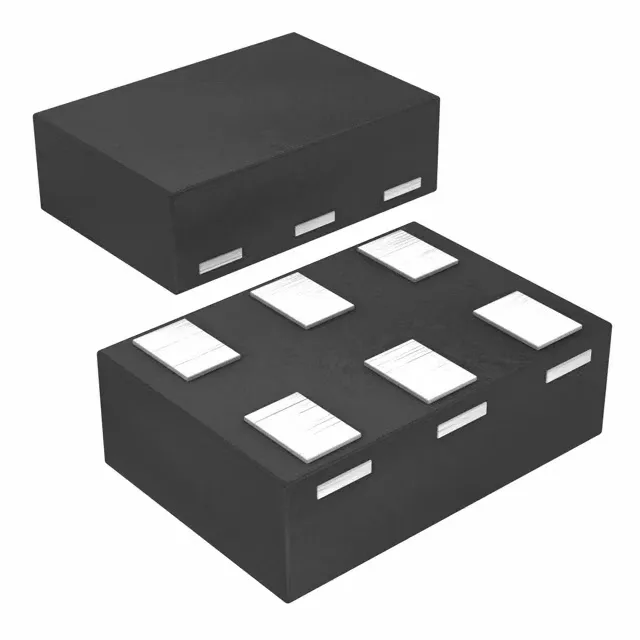
Housed in a 6-UFDFN (also marked as 6-SON) measuring 1.45mm x 1.0mm, this is a tiny no-lead package with exposed pads underneath. The land pattern requires a solder-paste stencil aperture matching the datasheet recommendation — too much paste and the part floats; too little and the center pad doesn't wet. MSL rating isn't stated in this listing, but for any SON package assume MSL 3 or higher: if the reel's moisture-barrier bag has been open longer than the floor-life window, bake the parts at 125°C for 24 hours before reflow. Surface-mount only, no through-hole option.
Listed as Active in the lifecycle status, with ROHS3 compliance. The 1P1G125QDRYRQ1 is the automotive-grade variant of the ubiquitous 74LVC1G125 — if your existing BOM uses the commercial-grade 74LVC1G125 in a non-automotive environment, you don't need this part. But if a design is migrating from prototype to production for a vehicle program, swapping to this AEC-Q100 version avoids a requalification cycle later.