Clamping performance at the transient event
The 1.5SMC9.1CAHR7G: The reverse standoff sits at 7.78 V typ, so the line idles cleanly below the breakdown threshold. Breakdown triggers no lower than 8.65 V, which means there is a 0.87 V window between nominal standoff and guaranteed turn-on — tight enough for 5 V rails but wide enough that noise immunity is not compromised in an automotive environment. The 1500 W peak pulse rating defines the energy the SMC package can absorb in the 10/1000 µs surge window. This is the 1.5 kW rating that puts the 1.5SMC family above the 500 W 5SMC class — you need it when protecting ECU supply rails against the ISO 7637-2 transient amplitudes that occur at the battery terminals.
Automotive grade and thermal margin
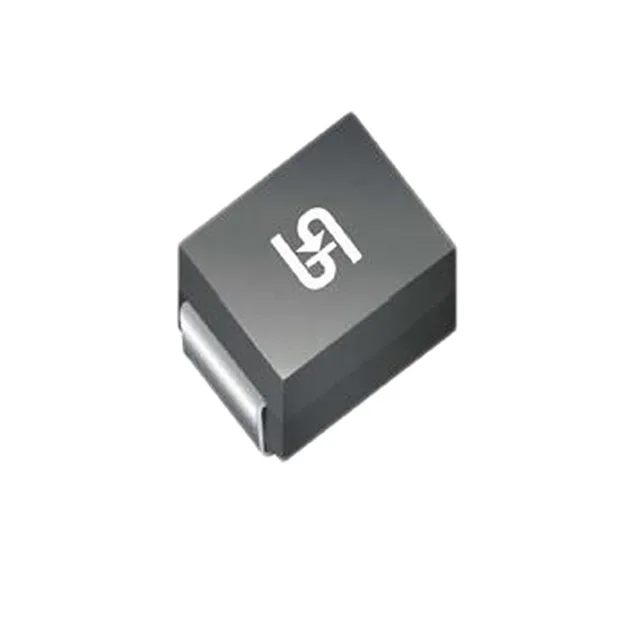
Junction temperature rating is -55°C to 150°C, which covers the engine-bay ambient band with margin: a 125°C board ambient at the SMC land still leaves 25°C of junction rise before the limit at rated pulse conditions. The DO-214AB (SMC) package with its exposed cathode pad on the bottom metalises heat to the PCB — thermal pad area drives the real-world clamping performance under repeated transients. A single 2:1 derating on copper pad area typically halves the thermal resistance versus a minimum-land layout.
Bidirectional polarity and circuit-level fit
Single bidirectional channel means it clamps both positive and negative transients — the polarity is not selectable at the board level. For a 12 V automotive rail the standoff sits comfortably above the nominal bus voltage with headroom for the transient overshoot before the clamp engages, which is the correct condition for a TVS protecting an ECU power input. Power Line Protection is listed as No — this part is designed for signal or load-side protection, not for deployment on the primary power bus as a branch protection element.