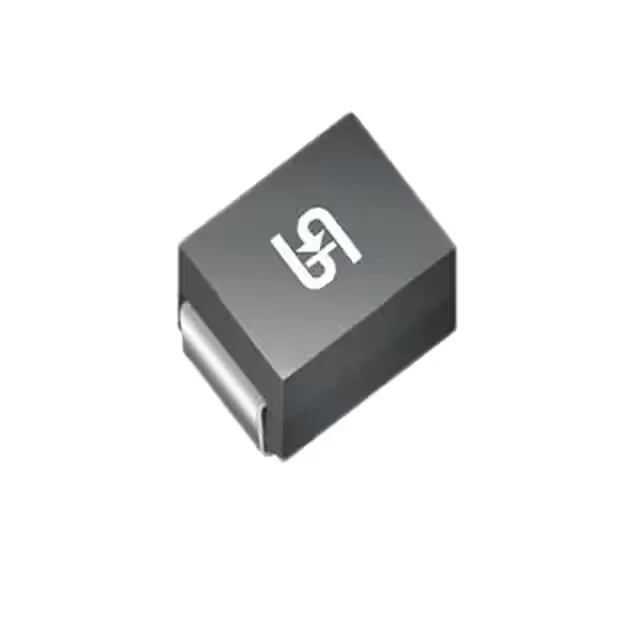
Clamping hierarchy — what the voltage ratings mean
The 1.5SMC68A R7G: This is a unidirectional Zener-type TVS (Transient Voltage Suppressor) — the device holds off at the rail's normal operating voltage and clamps transient surges before the downstream circuit sees damage. Choosing a TVS with the right standoff means the protected rail runs below the TVS conduction threshold with margin — the 58.1V standoff sits comfortably above a 48V nominal rail while leaving enough headroom below the 92V clamping ceiling for most downstream semiconductors to survive.
At that waveform, 1500W tells you the part survives the surge energy without failing short, which is the failure mode that would take out the downstream circuit with it. The 17A peak pulse current corresponds directly to the 92V clamping ceiling — the two specs are measured at the same event and must be read together: the downstream circuit sees 92V for the duration of the surge while the TVS absorbs the energy.
DO-214AB package and surface-mount fit
The DO-214AB (SMC) is the standard medium-power footprint for TVS diodes, Schottky barrier rectifiers, and fast recovery rectifiers in the 1–1.5 kW class. Surface-mount terminations simplify high-volume assembly and the wide metal tab under the body handles the thermal path — the diode junction sits at the die attach, and the tab-to-board pad area governs the thermal resistance to the PCB copper. No explicit thermal resistance is listed in the spec table, so check the Taiwan Semiconductor datasheet for the RθJA curve if the board layout runs the part near its temperature limit.