What the clamping specs mean for your protection circuit
The 1.5SMC8.2A M6G: The 7.02 V reverse standoff is the working voltage — above it the device begins to turn on, and the 7.79 V minimum breakdown marks the threshold where the TVS actively clamps. The 1.5 kW peak pulse rating at that waveform is the industry-standard 10/1000 µs figure; it does not scale to faster or slower transients, so the clamping voltage at a different pulse shape will differ from the listed 12.1 V. Unidirectional polarity — it clamps positive transients on a single polarity rail and does not conduct in reverse. If your circuit sees bidirectional or AC-swing transients, a dual-polarity or opposing-polarity pair is required; a single unidirectional TVS on a symmetric rail will clamp one polarity and forward-bias on the other.
SMC package and board integration
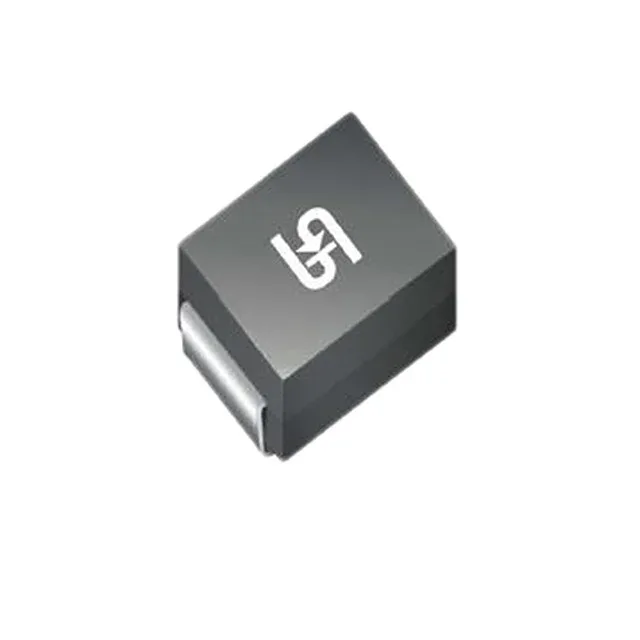
DO-214AB (SMC) is the mid-size TVS footprint — larger pad metal than a SMA, smaller than a SMB — and the cathodedirection band marks polarity on the reel. Surface-mount pick-and-place compatible. The junction temperature limit of 150 °C gives meaningful headroom above the 85–105 °C common in enclosed panels, but thermal resistance to the board still governs the continuous dissipation rating — verify the recommended land pattern for adequate heat spreading on high-current transients.