What the clamping specs mean for automotive boards
The 1.5SMC75AHM6G: The 64.1 V reverse standoff is the rail this Zener leaves undisturbed — it sits above a 12 V nominal line with 4× headroom, so it does not conduct during normal operation. That 103 V ceiling is what the downstream semiconductor sees during a load-dump event, so the circuit's abs-max rating must survive that clamping level without degradation. At 1.5 kW peak pulse power, the 1.5SMC series handles the 10/1000 µs surge profile specified in automotive transients — this is the classic load-dump pulse width. The part is unidirectional, which means polarity matters: it clamps positive transients only. A bidirectional protection need requires a different polarity or a bidirectional TVS part.
Automotive grade — what AEC-Q101 means here
AEC-Q101 qualification is the automotive discrete semiconductor stress standard — it verifies the part survives temperature cycling, humidity bias, and surge stress at the junction temperature limits. This is a power-line protection exclusion part — the spec explicitly marks Power Line Protection as No. That means it is designed for signal-line or local rail clamping, not as the primary protection element on the unswitched 12 V supply rail. Designers who need the latter should check the 1.5SMC series for the power-line-qualified variant.
DO-214AB SMC package and assembly
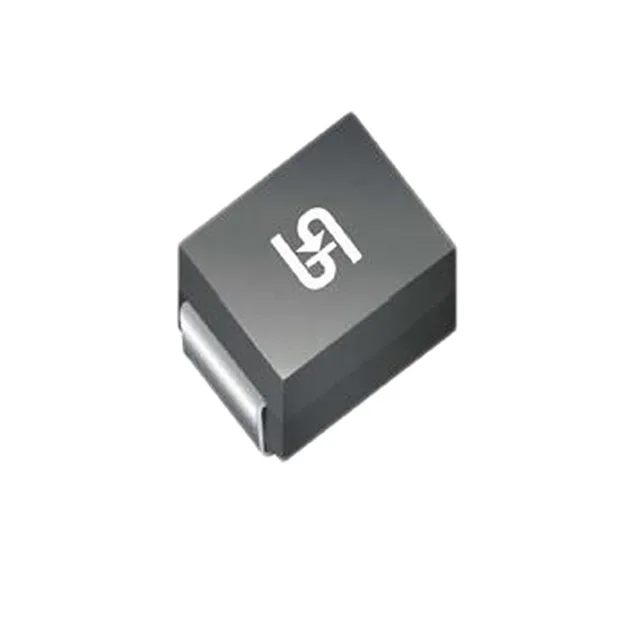
The DO-214AB (SMC) is the mid-size TVS package — larger than the SMA but smaller than the SMB. The cathode band identifies polarity on the unidirectional part, which matters for pick-and-place orientation. Tape-and-reel packaging is standard for high-volume assembly runs; confirm the reel count matches the assembly feeder capacity.