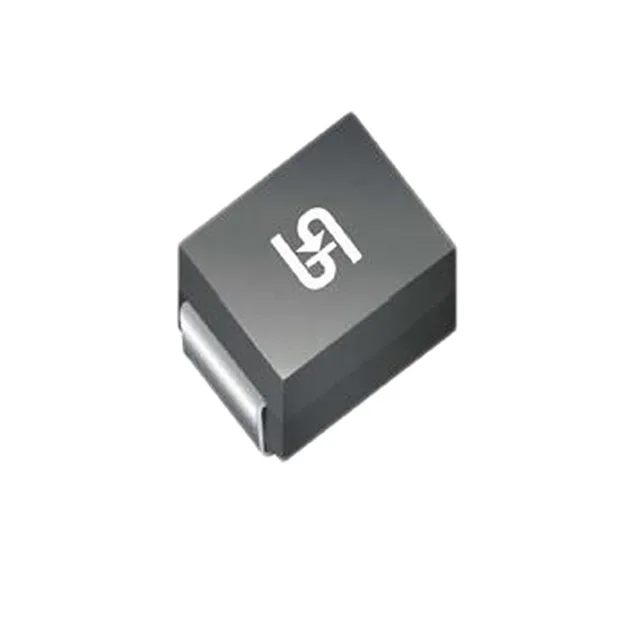
Transient protection at 1500 W peak pulse
The 1.5SMC68AHR7G: That peak-pulse rating is the device's thermal SOA — it tells you how much energy the junction can absorb during a single transient event without shifting its electrical characteristics. For automotive ECU inputs, this figure governs the survivable load-dump and reverse-battery pulse that the wiring harness injects into the protected node.
What the voltage ratings mean in a circuit
Standoff voltage is 58.1 V typical — the DC bias the protected node sits at during normal operation; the TVS stays off and draws only leakage current. Breakdown voltage minimum is 64.6 V — when the transient pushes the node above this threshold, the TVS clamps and begins conducting. Clamping voltage maximum is 92 V at the rated peak pulse current of 17 A — that 92 V ceiling at the protected input is what the downstream semiconductor must survive. A downstream IC with a 60 V absolute-max rating sits comfortably behind that clamping level, assuming the source impedance limits the let-through current to the 17 A test condition.
Automotive grade and thermal margin
AEC-Q101 qualification means the part passed temperature cycling, high-temperature reverse bias, humidity bias, and pulsed-current stress at the wafer level — the conditions that matter for engine-compartment and chassis-adjacent deployments. The 150 °C upper limit gives headroom against the 125 °C ambient that an under-hood ECU enclosure reaches on a hot day before the thermal pad and board copper carry the heat away.
Active lifecycle — BOM sourcing posture
Taiwan Semiconductor Corporation lists this part Active.