Clamping voltage and peak pulse power — what the numbers decide
The 1.5SMC62AH: That 85 V ceiling is the number that governs what reaches the protected load — in a 48 V telecom rail or a 12 V automotive distribution bus, a surge that would otherwise spike to 200 V gets clamped here before it reaches downstream ICs. 1500 W peak pulse power means the device survives single-event transients — motor inductance kick, ESD human-body model — within its rated 10/1000 µs duration without thermal runway. The Tj max of 150 °C and the wide -55 °C lower limit tell you this is qualified for engine-bay and outdoor-equipment ambient bands, not just cabin interior.
AEC-Q101 qualification — the automotive grade signal
The device carries an AEC-Q101 qualification grade — this is the automotive discrete semiconductor stress suite (temperature cycling, humidity, mechanical shock, ESD human-body and machine model). For an under-hood ECU, a chassis-module, or a telecom base-station power entry point, AEC-Q101 is the floor, not a feature. Grade is Automotive, not industrial. That distinction drives PPAP documentation requirements — the OEM auditor will ask for the PPAP package and the Cpk data on the 53 V standoff and 85 V clamping parameters. Confirm the date code and wafer-lot traceability at RFQ if your quality system requires it.
DO-214AB SMC footprint and SMT assembly
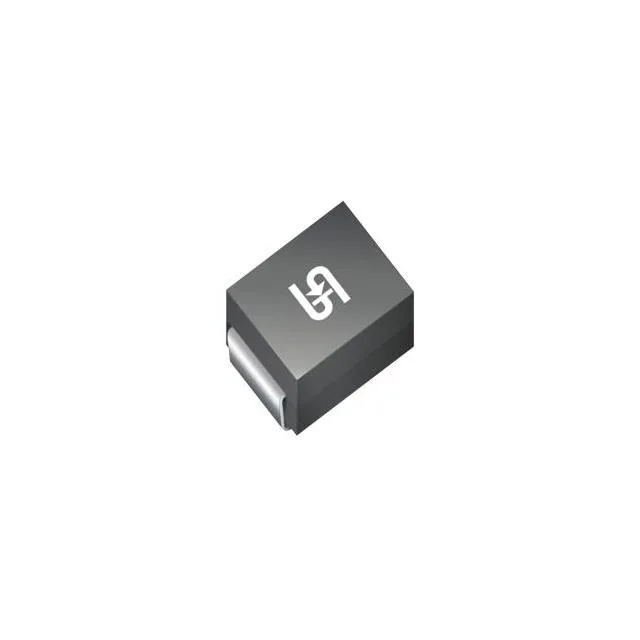
DO-214AB (SMC) is a common large-SMD footprint — the cathode band marks the polarity end. The Tape & Reel (TR) packaging suits high-volume placement on an automotive ECU or telecom line card. Confirm the land-pattern dimensions against your layout — the SMC sits between the smaller SMA and the larger SMB in the DO-214 family.