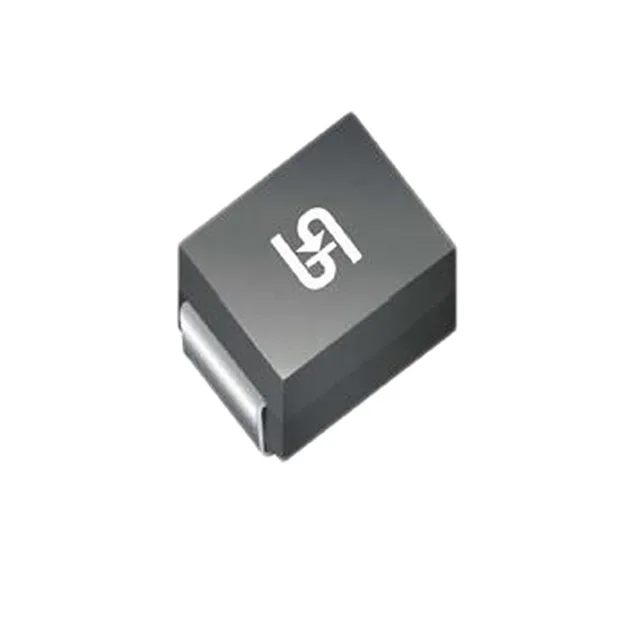
Peak pulse ratings — what 1500 W means for the protection circuit
The 1.5SMC6.8AHR7G: This energy handling is the deciding spec — it tells you the device survives a single-event surge without degradation, and that the downstream circuitry sees no more than 10.5 V at the clamp point regardless of the incoming spike amplitude.
Breakdown and standoff — the voltage window
The Zener breakdown minimum is 6.46 V; the typical reverse standoff is 5.8 V — the part sits dormant below 5.8 V and begins conduction somewhere between 5.8 V and 6.46 V as the transient rises. This 1 V of headroom between standoff and breakdown is typical for the 1.5SMC series and reflects the Zener characteristic: the device holds off the supply rail and activates only when a genuine transient exceeds the breakdown threshold. At the clamping voltage of 10.5 V, the downstream bus sees a hard ceiling — a transient that might otherwise reach tens or hundreds of volts is folded down to a survivable level for sensitive electronics.
Automotive grade and thermal margin
AEC-Q101 qualification puts this part in the automotive discrete semiconductor class — it has passed temperature cycling, humidity bias, and surge testing per the automotive electronics council stress test qualification. The junction operating range of -55°C to 150°C (TJ) covers engine-bay and chassis-side deployments where ambient temperatures routinely exceed commercial limits; the 150°C ceiling gives headroom above the typical 125°C automotive under-hood grade. The DO-214AB (SMC) surface-mount package is the standard leadless clip-mount footprint for this power class — confirm pad layout and solder thermal profile against the landing pattern for the clamping performance to hold under surge conditions.