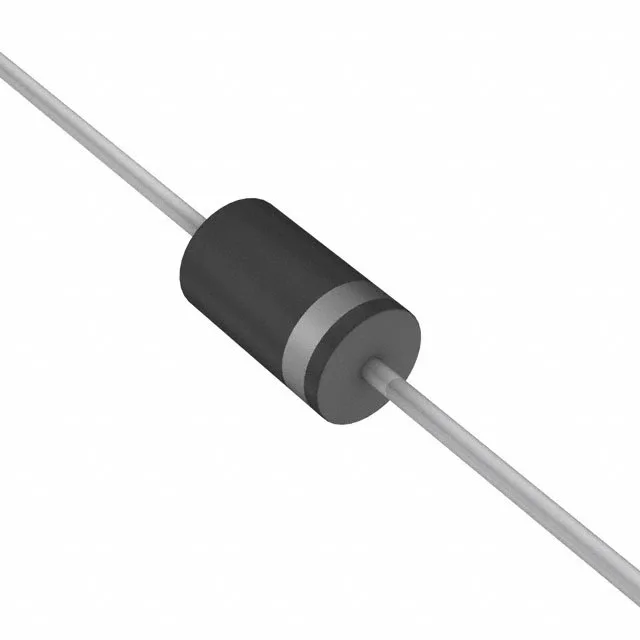
Active production — still a first-choice BOM line
The 1.5KE39CA A0G: No last-time-buy clock is ticking, and no successor part has been issued. For a BOM that already has this DO-201 footprint and 33.3 V standoff, it is a stable line item — no redesign pressure from obsolescence.
What the 1500 W rating actually buys you
That is the energy it can absorb and clamp in a single surge event before the junction overheats. The clamping voltage at that peak current is 53.9 V — so a 24 V or 28 V rail protected by this part sees the transient clipped to under 54 V, well within the margin of most downstream regulators and capacitors. The reverse standoff of 33.3 V means it sits silently on the rail during normal operation, drawing negligible leakage, and only starts conducting when the line exceeds about 37 V (the minimum breakdown voltage,).
Bidirectional — one part covers both polarities
A single bidirectional channel means the same device clamps a positive transient above breakdown and a negative transient below the reverse breakdown (which is symmetric in a bidirectional Zener structure). Useful on AC-coupled signal lines, data pairs, or any rail where the fault polarity is unknown. No need to series two unidirectional parts back-to-back — one DO-201 axial part does it.
Temperature range for real environments
That covers the full industrial temperature band and reaches into the under-hood automotive zone. The 175 °C ceiling is the die's absolute limit — derate the peak pulse power above 25 °C per the datasheet curve (the 1500 W rating is at 25 °C). In a hot enclosure or near an engine block, the effective surge capability drops; budget accordingly.