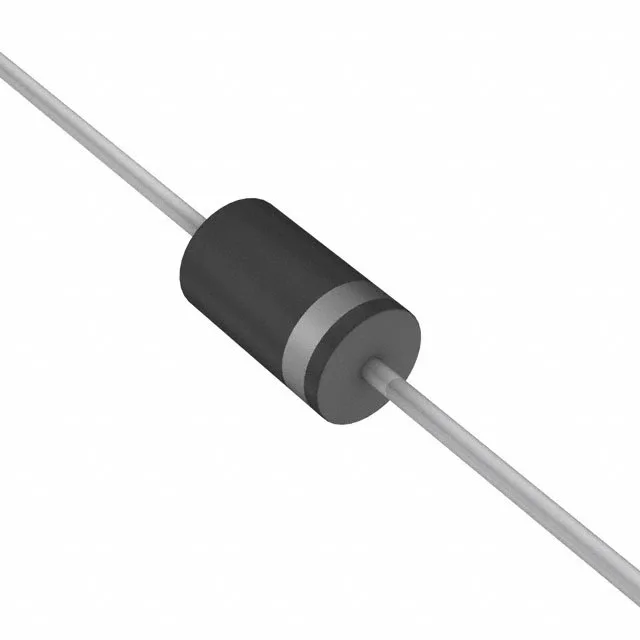
Zener TVS for 28V rail protection
The 1.5KE30A B0G: With a 25.6V reverse standoff voltage, it sits below the rail's steady-state maximum and begins conducting at the 28.5V minimum breakdown point, clamping the surge to 41.4V maximum at the 38A peak pulse current (10/1000µs waveform). The DO-201AA axial-lead package (also known as DO-27) mounts through-hole, suited for point-of-entry clamping on a PCB or terminal block.
Clamping voltage and pulse current
The 41.4V maximum clamping voltage at 38A Ipp (10/1000µs) is the voltage the protected circuitry sees across the diode during the surge. For a 28V-rated downstream component, the 13.4V headroom above standoff is the margin the TVS provides — if the load's absolute maximum rating is below 41.4V, a lower-clamp part or additional series impedance is needed. The 38A peak pulse current is specified for the standard 10/1000µs waveform (IEC 61000-4-5 combination wave). For shorter pulses (8/20µs), the peak current capability is higher — the 1500W energy rating is the constant; the current scales inversely with pulse width. The unidirectional channel (single diode) handles positive-going transients; a reverse-polarity event forward-biases the junction and may exceed the 5W steady-state dissipation.
At 175°C junction, the leakage current at standoff voltage increases significantly — the datasheet's 25.6V standoff leakage figure (typically 1µA at 25°C) can rise to tens of microamps at high temperature, which matters for battery-powered or high-impedance circuits where leakage affects quiescent draw. The part is not rated for power line protection (no built-in overvoltage lockout or series element) — it is a shunt clamp for signal or low-power DC rails. For AC mains or high-energy surges, a metal-oxide varistor (MOV) or gas discharge tube (GDT) in front of the TVS is the conventional cascade.
The base product number is 1.5KE30, with the B0G suffix indicating the bulk packaging variant. The same die is also available in tape-and-reel (1.5KE30A R0G) for automated assembly.