What the 1500W rating means for a surge event
The 1.5KE250A A0G: That 1500W figure is the energy the die absorbs in a single pulse without exceeding the junction temperature limit; it is not a continuous dissipation rating. For a 344V clamp voltage, the peak current is 4.5A, so the device shunts a 4.5A surge for one millisecond and recovers.
Standoff, breakdown, and clamp — the three voltages that define fit
The reverse standoff voltage is 214V — this is the DC bus voltage the TVS sees during normal operation without conducting. The breakdown voltage range starts at 237V, so the device begins to avalanche above that threshold. The clamping voltage is 344V maximum at the rated peak current; the downstream circuitry must survive this peak without damage. A 240VAC line rectified to ~340VDC is too close to the standoff — this part is better suited for 190–210VDC rails or 120VAC rectified and filtered.
Unidirectional — when to use it and when to pick the bidirectional sibling
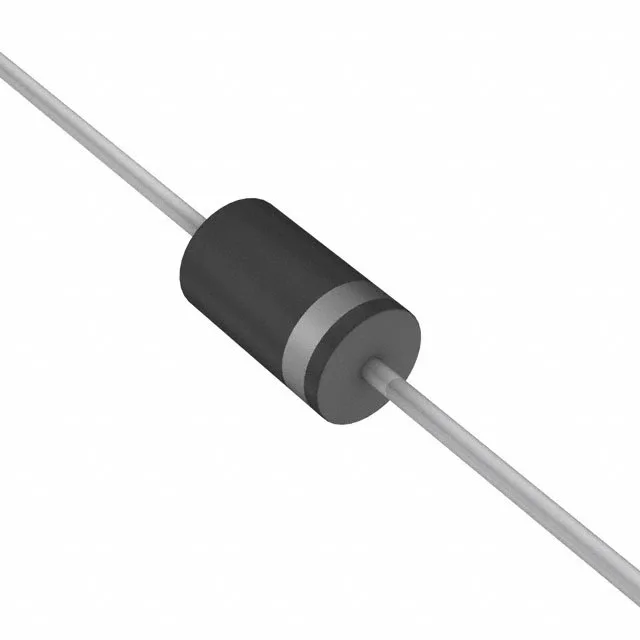
The 1.5KE250A A0G is a single unidirectional channel with the cathode band marked on the DO-201 body. It clamps positive surges above the breakdown voltage and forward-conducts negative surges like a standard diode. For AC signal lines or bipolar supply rails where the surge can swing both polarities, the bidirectional variant 1.5KE250CA is the correct choice — it has back-to-back Zener junctions and no polarity marking.
Temperature range and package — where it fits on the board
The junction temperature range spans -55°C to 175°C, covering industrial enclosures and under-hood automotive environments. The DO-201AA axial-leaded package has a body diameter of 5.6 mm and a lead diameter of 1.3 mm (0.052 inch), fitting standard 0.8 mm to 1.0 mm PCB holes. Through-hole mounting with the leads formed to a 5 mm pitch is typical; the axial body stands off the board when the leads are bent 90 degrees.