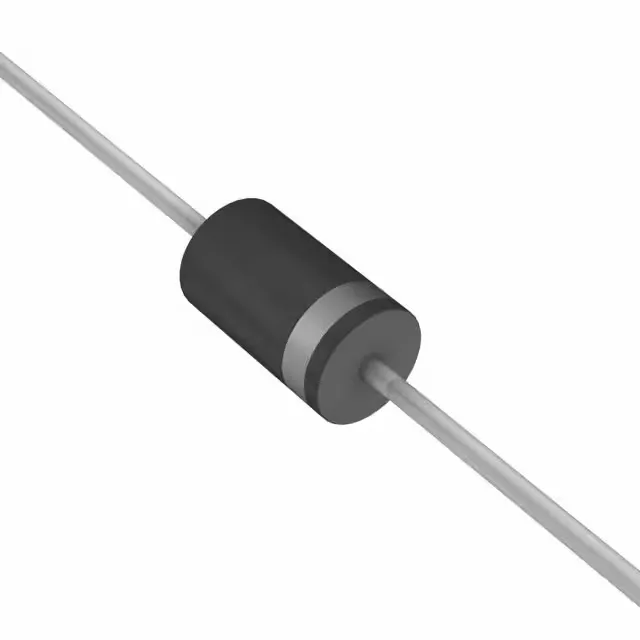
1.5 kW bidirectional TVS for 12 V rail clamping
The 1.5KE15CA R0G: Its 12.8 V reverse standoff voltage sits just above the 12 V rail, so it stays out of conduction during normal operation but fires at 14.3 V minimum breakdown to shunt a surge to ground. This is the number that matters for the downstream component's voltage rating: anything rated for 25 V or higher has margin.
What the ratings mean for the BOM decision
The 1500 W peak pulse power (1.5 kW) is the energy-handling headline for an 8/20 µs or 10/1000 µs surge. For a 12 V battery line or a 12 VDC supply rail, this part absorbs a transient that would otherwise punch through a regulator or an IC input. The 21.2 V clamp means the protected device sees no more than that peak — a 25 V-rated capacitor or a 30 V-rated MOSFET has comfortable headroom. Bidirectional (one channel) means it clamps both polarities with a single device — useful on AC-coupled signal lines or on a DC rail where reverse-voltage events are possible.
Package and rework reality
Through-hole DO-201AA (DO-27 axial) package — two leads, one band marking the cathode for unidirectional parts, but on this bidirectional variant orientation is irrelevant. The axial leads are robust for hand-soldering or wave-solder; the body is large enough that a hot-air station can remove it cleanly without lifting the through-hole pad, provided the solder is fully molten before pulling. Supplied in tape and reel (R0G suffix) for automated insertion, but equally easy to hand-place for prototypes or rework. No exposed thermal pad to worry about — the leads conduct the heat away during soldering, and the junction-to-lead thermal path is the only one that matters for pulse dissipation.