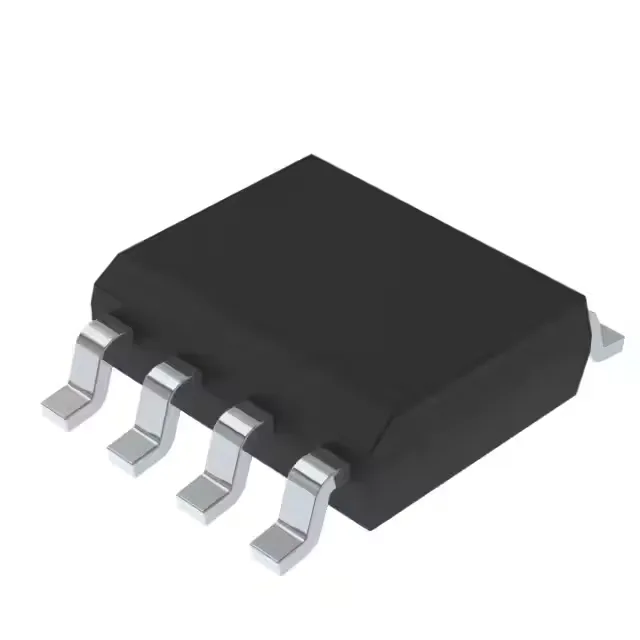
Dual CMOS op-amp for low-power industrial signal chains
Each amplifier draws 150 µA supply current, making it a fit for multi-channel sensor interfaces, battery-monitoring circuits, and 4–20 mA loop transmitters where the total current budget is tight. The 1 MHz gain-bandwidth product and 0.6 V/µs slew rate are enough for low-frequency signal conditioning — thermocouple amplifiers, strain-gauge bridges, and control-loop filters — without wasting power on bandwidth you do not need. The supply range spans 3 V to 16 V, so it runs from a single 3.3 V rail or a 12 V industrial bus without a secondary regulator.
At 0.6 V/µs, the TS27M2IDT delivers a full-power bandwidth of roughly 9.5 kHz at 10 V peak-to-peak output. That is fine for audio-frequency filtering, PWM-conditioning, and slow ADC drive stages. If your design needs to swing 10 V at 20 kHz or above, the TS274IPT with 5.5 V/µs is the faster sibling — but it draws 1 mA per channel, nearly seven times the supply current. The TS27L2IDT drops to 0.04 V/µs and 10 µA per channel, which is the ultra-low-power option for sub-100 Hz sensor nodes. The TS27M2IDT sits in the middle: enough slew for most industrial signal chains without burning the battery.