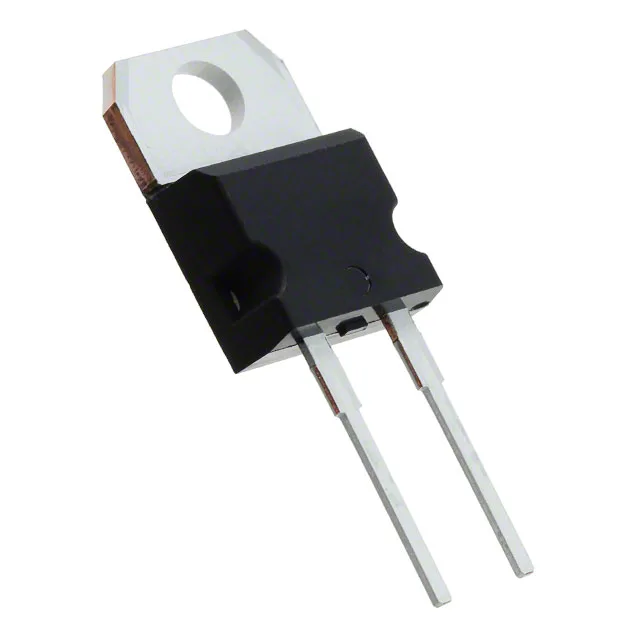
Zero-recovery SiC Schottky for hard-switched power stages
The STPSC606D: Its zero reverse recovery time (0 ns trr) eliminates the minority-carrier storage effect that plagues ultrafast silicon diodes, so the switching node sees no reverse-recovery current spike. This makes the part a natural fit for the boost diode in power factor correction (PFC) stages, freewheeling diode in flyback converters, and the output rectifier in resonant LLC topologies where switching loss and EMI are design constraints.
Forward drop and leakage — the conduction trade-off
Maximum forward voltage is 1.7 V at 6 A, 25 °C junction — the conduction loss at rated current is about 10.2 W, which the TO-220AC package dissipates when bolted to a heatsink with thermal interface material. The 375 pF junction capacitance at 0 V (1 MHz) contributes to the turn-off energy; in a 100 kHz PFC stage the capacitive switching loss is manageable but should be factored into the thermal model. Reverse leakage is 75 µA at 600 V, 25 °C — typical for a 600 V SiC Schottky. Leakage doubles approximately every 10 °C junction rise, so at 150 °C it approaches 1–2 mA. In standby-power-sensitive designs this may matter; for continuous conduction the leakage power is negligible compared to the forward loss.
Junction temperature range is -40 °C to 175 °C. The 175 °C maximum allows the diode to run at high junction temperatures without derating the current — useful in sealed power supplies, motor drives with limited airflow, and outdoor telecom rectifiers where ambient can reach 85 °C. The TO-220AC package has a standard 2.54 mm pitch, fits most TO-220 heatsink clips, and the tab is the cathode. For a 6 A continuous application a 20–30 °C/W heatsink keeps the junction below 125 °C in a 50 °C ambient.
Lifecycle and supply posture
ROHS3 compliant (no exempt substance expiry).