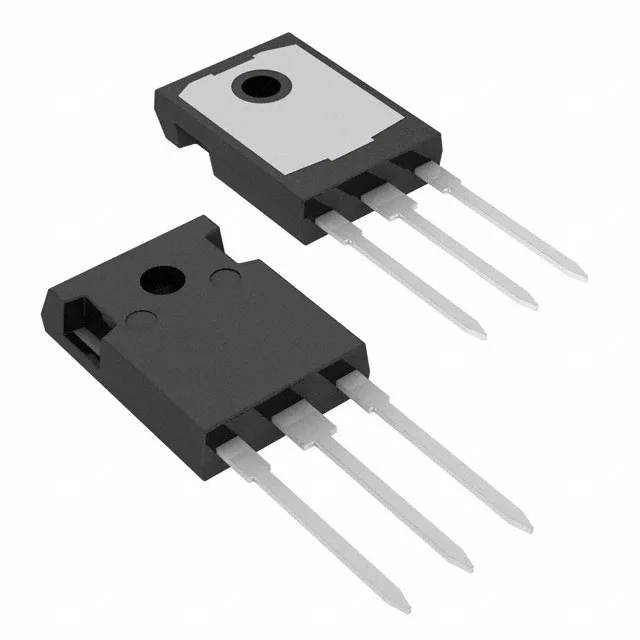
1200 V SiC Schottky — zero-recovery dual diode in TO-247
The STMicroelectronics STPSC40H12CWL is a silicon-carbide Schottky rectifier rated for 1200 V blocking voltage and 38 A average forward current per diode, configured as a common-cathode pair in a single TO-247-3 through-hole package. The SiC material gives it zero reverse recovery time (trr = 0 ns), which eliminates the turn-off loss spike and snubber components that plague ultrafast silicon diodes in hard-switched PFC, inverter, and flyback stages. The junction is rated for continuous operation from -40°C to 175°C, suiting it for high-density power supplies, motor drives, and solar inverters where thermal margin and switching efficiency drive the BOM.
The datasheet lists reverse recovery time as zero nanoseconds (trr = 0 ns). In practice, SiC Schottky diodes exhibit no stored charge, so the reverse-recovery current spike that causes EMI and extra dissipation in a silicon FRED simply does not exist. This lets the designer use a smaller or slower main switch without worrying about diode-induced turn-on loss, and it shrinks the snubber network to a minimal RC or none at all. For a 1200 V bus, the 120 µA reverse leakage at rated voltage is low enough to avoid thermal runaway at high junction temperature, but it does rise with temperature — the 175°C limit is real, not a marketing number.
Common-cathode pair — topology fit
The two diodes share a common cathode on the tab and center pin, with the anodes on the outer pins. This is the standard footprint for a center-tapped secondary in a full-wave rectifier, a boost PFC with interleaved phases, or a dual-output clamp. Each diode handles 38 A average; the TO-247-3 package is a through-hole part with a large copper tab that bolts to a heatsink or chassis — the thermal path is the limiting factor, not the silicon. The ECOPACK® series designation means the part is manufactured with halogen-free, RoHS-compliant materials per ST's environmental program.