The zero reverse recovery time (trr = 0 ns) means no recovery charge to manage — the diode turns off the instant the voltage reverses, which cuts switching losses in hard-switched topologies like boost PFC, LLC converters, and inverter output stages. Junction temperature spans -40°C to 175°C, so it handles the thermal cycling of industrial motor drives and onboard chargers without derating at the high end.
Common-cathode layout — one package, two diodes
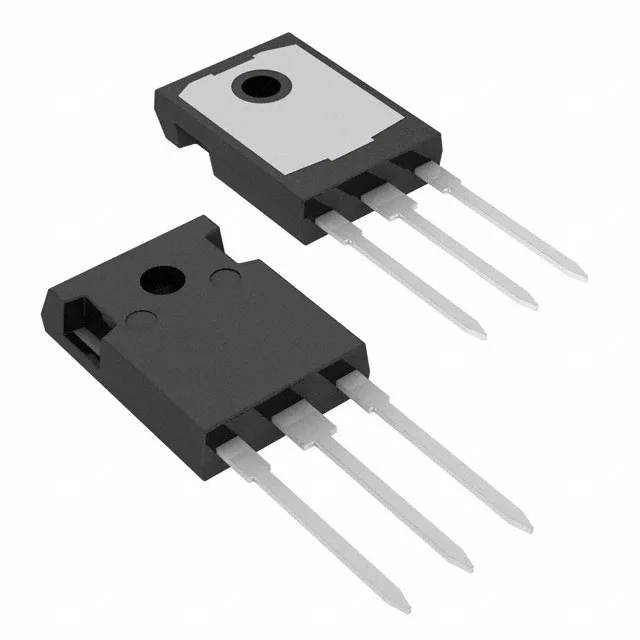
Both anodes are independent; the cathodes share the center pin. That maps directly to a boost PFC stage where the two diodes form the high-side and low-side rectifiers with a shared output rail, or to the top half of a three-phase bridge. The TO-247-3 through-hole package fits standard heatsink clips; the isolated backside tab is at cathode potential, so a single thermal pad works for both dies.
Zero reverse recovery — why it matters for the BOM
The SiC Schottky eliminates recovery charge entirely — the recovery current is just the junction capacitance discharge. That lets you reduce snubber values and run the switching frequency higher without thermal penalty.
Lifecycle and compliance — active, RoHS, ECOPACK
It is part of the ECOPACK series, meaning the package and plating meet RoHS and halogen-free requirements per ST's own qualification.