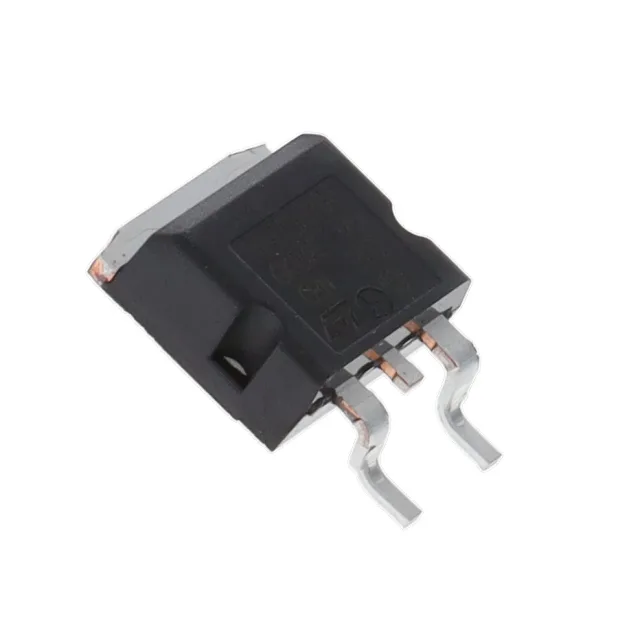
The STPSC15H12G2-TR is a 1200 V, 15 A Silicon Carbide Schottky diode from STMicroelectronics, part of the ECOPACK®2 series. The zero reverse recovery time (0 ns trr) is the defining characteristic — it eliminates the reverse-recovery charge that causes switching losses and EMI in silicon ultrafast diodes, making this part a direct fit for hard-switching topologies like continuous-conduction-mode (CCM) power-factor-correction (PFC) stages and high-frequency DC-DC converters. The 1200 V blocking voltage provides margin for 400 VDC bus rails (typical in three-phase industrial drives and EV on-board chargers) and handles the voltage overshoot on turn-off without avalanche stress. The 15 A average current rating at a 175°C maximum junction temperature means the diode can deliver full rated current in high-ambient environments, provided the D2PAK HV footprint is properly heatsunk through the PCB thermal pad.
Zero-recovery switching — the SiC advantage over silicon
The 0 ns reverse recovery time (trr) is not a typical datasheet value — it is a physical consequence of the Schottky barrier in SiC. A silicon ultrafast diode with a comparable 1200 V / 15 A rating (e.g., a 1200 V, 15 A Hyperfast) will have a trr in the 30–60 ns range with a soft-recovery characteristic. That recovery charge generates a current spike that increases turn-on loss in the switching transistor and adds conducted EMI. The STPSC15H12G2-TR eliminates that spike entirely, which simplifies snubber design and lets the converter run at higher switching frequencies for the same thermal budget. The forward voltage is 1.5 V maximum at 5 A. At the full 15 A rating the forward drop is higher, but the zero-recovery switching means total loss at high frequency is still lower than a silicon diode with significant Qrr.
D2PAK HV footprint and thermal management
The D2PAK HV (High Voltage) package is a surface-mount D²PAK variant with extended creepage distance between the anode and cathode terminals to meet the 1200 V isolation requirement. The 1200 pF capacitance at 0 V, 1 MHz is the junction capacitance; it determines the capacitive switching loss at high frequency and is comparable to a silicon ultrafast diode of the same current rating. The reverse leakage current is 90 µA at 1200 V and 25°C — this is a Schottky characteristic that increases exponentially with junction temperature. At 175°C the leakage can rise to several milliamps, which must be included in the standby loss budget for applications that idle at high temperature.