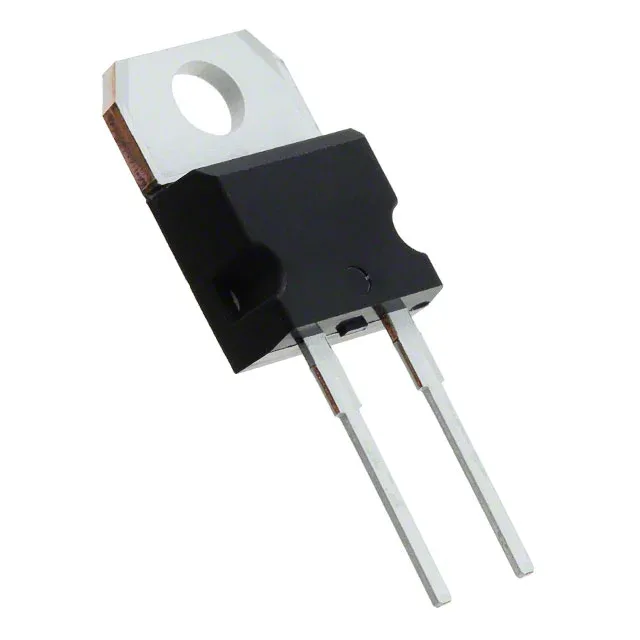
SiC Schottky — no recovery charge to manage
Its zero reverse recovery time (trr = 0 ns) eliminates the switching loss tail that plagues silicon ultrafast diodes in hard-switched converters.
The 12 A average rectified current (Io) is the continuous forward current the part can handle in a typical single-diode rectifier circuit. At 12 A the forward voltage drop is 1.7 V max, so conduction loss is about 20 W — the TO-220AC package with a heatsink is mandatory at that current. The 600 V reverse voltage (Vr) sets the DC bus or PFC rail ceiling. In a 400 V PFC stage the diode sees 400 V plus ringing; 600 V gives enough headroom for a 1.5× derating factor. Reverse leakage at 600 V is 150 µA, which is negligible for conduction loss but does contribute to self-heating at high junction temperatures. The 750 pF capacitance at 0 V is the output capacitance the switching node charges and discharges each cycle.
Zero trr — the SiC advantage
This eliminates the reverse-recovery current spike that causes EMI and extra loss in silicon ultrafast diodes. In a continuous-conduction-mode PFC stage, swapping a silicon diode for this SiC part can cut switching losses by 80 % or more.
Active production, no obsolescence watch
It is ROHS3 compliant.