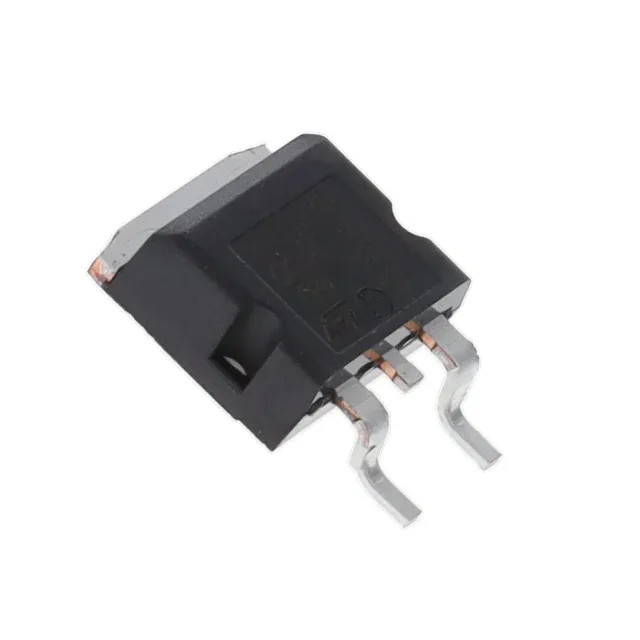
Silicon Carbide Schottky for high-frequency power stages
Reverse recovery time is listed at 0 ns, and the speed rating notes no recovery time above 500 mA. In a hard-switched bridge leg, that means the diode never conducts through the MOSFET body diode during dead time — the stored charge that causes ringing and EMI in silicon diodes simply does not exist. The 750 pF capacitance at 0 V is the junction capacitance you see on the datasheet; it charges and discharges every cycle, but there is no reverse-recovery charge to extract. This keeps the switching node clean and lets you run higher frequencies without derating the output current.
Forward drop and leakage at the operating point
That is higher than a silicon Schottky of the same voltage class, but the zero-recovery benefit usually offsets the conduction loss in any design switching above 50 kHz. Reverse leakage at 600 V is 50 µA — negligible for the power stage, but worth noting if the diode sits across a high-impedance node in a snubber or clamp circuit.
The D²PAK (TO-263-3) has an exposed metal tab that carries the cathode.