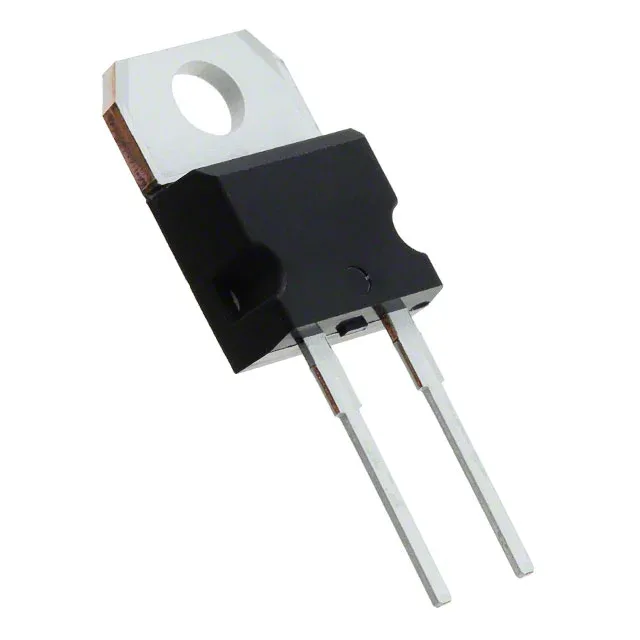
What this SiC Schottky does — and why the zero trr matters
Its headline feature is a reverse recovery time (trr) of 0 ns — a property of the SiC Schottky barrier that eliminates the reverse-recovery charge pulse that plagues silicon ultrafast diodes. In a hard-switched PFC or DC-DC converter, that zero trr means the diode contributes no switching loss and no ringing at turn-off, which simplifies snubber design and improves efficiency.
1200 V blocking, 10 A forward — where it fits in the power stage
With a DC reverse voltage rating of 1200 V and an average rectified current of 10 A, this diode is sized for the boost stage of a 3-phase PFC, the output rectifier in an EV onboard charger, or the freewheeling diode in a high-voltage DC-DC converter. The forward voltage drop is 1.5 V maximum at 10 A — typical for a SiC Schottky of this current class. The 725 pF capacitance at 0 V and 1 MHz is the junction capacitance you budget for in the switching node; it is lower than a comparable silicon ultrafast diode, which helps keep the turn-on loss down in the companion MOSFET or IGBT.
AEC-Q101 and the automotive bill-of-material
The 'Y' suffix in STPSC10H12DY marks the AEC-Q101 qualified variant. For a BOM targeting under-hood or chassis-domain power stages, this is the version the PPAP paperwork expects. The base part STPSC10H12D is the commercial-grade sibling — same die, same package, but without the automotive qualification paperwork. If your design does not require AEC-Q101, the commercial part is a cost-effective alternative; if it does, the STPSC10H12DY is the correct line item.
The part is also listed under the ECOPACK® series, indicating compliance with ST's lead-free and RoHS-compliant packaging policy.