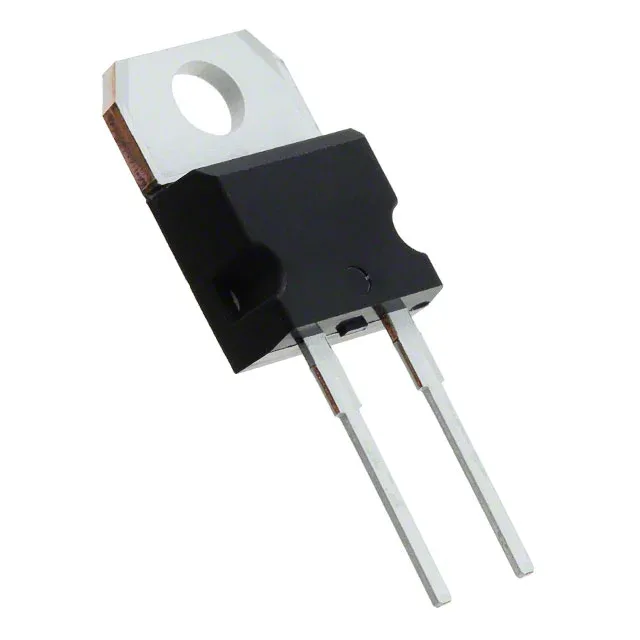
SiC Schottky with zero recovery — what it means for your switching stage
The STPSC10H12D is a 1200 V, 10 A silicon carbide Schottky diode in a TO-220-2 through-hole package. Its zero reverse recovery time (trr = 0 ns) means the diode contributes no turn-off switching loss — the dominant loss mechanism in a hard-switched PFC or inverter stage shifts entirely to conduction loss, simplifying thermal management at high frequencies.
1200 V blocking with 10 A continuous — sizing the bus and load
Rated for 1200 V DC reverse voltage, this diode comfortably blocks the DC bus of a 3-phase 400 VAC drive (typical bus ~565 V) with margin for transients. The 10 A average rectified current (Io) is the continuous forward rating at the case temperature; derate for higher ambient or reduced heatsinking per the datasheet curve. Forward voltage is 1.5 V maximum at 10 A and 25°C junction — conduction loss at full load is 15 W, which the TO-220AC package must shed through a heatsink. The 725 pF junction capacitance at 0 V, 1 MHz is typical for a 10 A SiC die; it drops with reverse bias, so capacitive switching loss at high bus voltage is lower than the zero-bias figure suggests.
Temperature range and leakage — the thermal budget
Operating junction temperature spans -40°C to 175°C, covering industrial enclosures and under-hood automotive zones. Reverse leakage is 60 µA at 1200 V and 25°C; like all SiC Schottkys, leakage rises exponentially with temperature — at 150°C junction it can increase 10-20×, so the thermal design must budget the additional power from leakage at high bus voltage.
STMicroelectronics lists the STPSC10H12D as Active (current production). The part is ROHS3 compliant, meeting EU material restrictions for new designs. No stock-holding claim — quoted to order.