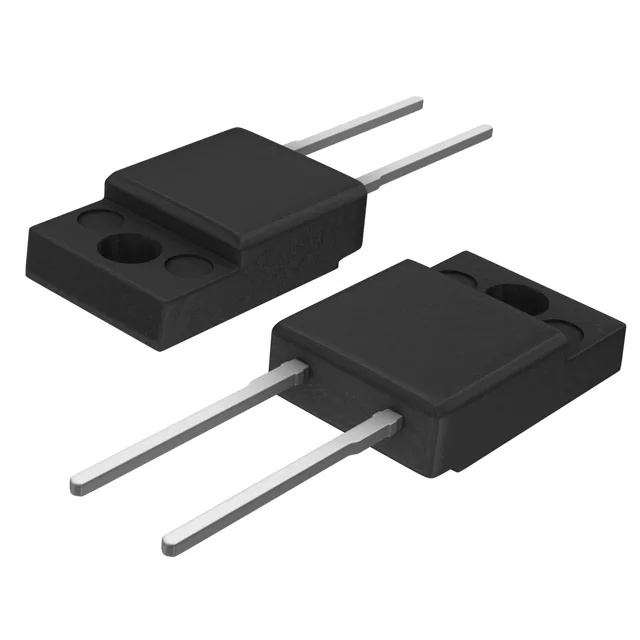
STMicroelectronics STPS8H100FP — Discrete Semiconductors

STPS8H100FP 100V 8A Schottky Rectifier, TO-220FPAC, Active

MPNSTPS8H100FP
Active

STMicroelectronics STPS8H100FP, 100 V, 8 A Schottky rectifier, Fast Recovery ≤ 500 ns, TO-220-2 Full Pack isolated tab, through hole, 710 mV Vf at 8 A, 175 °C junction, active.

$2.0100Ref. price · indicative, final on quote
PackagingTO-220-2 Full Pack, Isolated Tab
RoHSROHS3 Compliant
Independent supplier — new & surplus stockAuthenticity-screened · ESD-safe packingListing updated Aug 2026

Specifications

STPS8H100FP specifications
ParameterValue
MountingThrough Hole
Voltage - DC reverse (Vr)100 V
Voltage - forward (Vf) (Max) @ if710 mV @ 8 A
Current - reverse leakage @ vr4.5 µA @ 100 V
Current - average rectified8A
Operating temperature - junction175°C (Max)
SpeedFast Recovery =< 500ns, > 200mA (Io)
PackageTube
TechnologySchottky
CaseTO-220-2 Full Pack, Isolated Tab

Product details

100 V, 8 A Schottky — rectifier stage fit

The STPS8H100FP is a 100 V, 8 A Schottky rectifier from STMicroelectronics, housed in a TO-220 Full Pack isolated tab package (TO-220FPAC). It is designed for high-frequency rectification in power supplies, freewheeling diodes in DC-DC converters, and reverse-polarity protection circuits where low forward voltage drop and fast recovery are needed.

Forward drop and thermal budget at 8 A

The junction temperature is rated to 175 °C. Reverse leakage is 4.5 µA at 100 V, typical for a Schottky at this voltage class. Leakage rises with junction temperature, so the thermal design should account for increased leakage at high load or ambient conditions.

Frequently asked questions

Can STPS8H100FP be used as a replacement for STPS8H100D?

The STPS8H100D is a D²PAK surface-mount variant of the same die. The STPS8H100FP is the through-hole TO-220 Full Pack version. Electrically they are equivalent in voltage, current, and forward drop, but the package and footprint differ — the FP version requires a through-hole PCB layout and isolated-tab heatsinking.