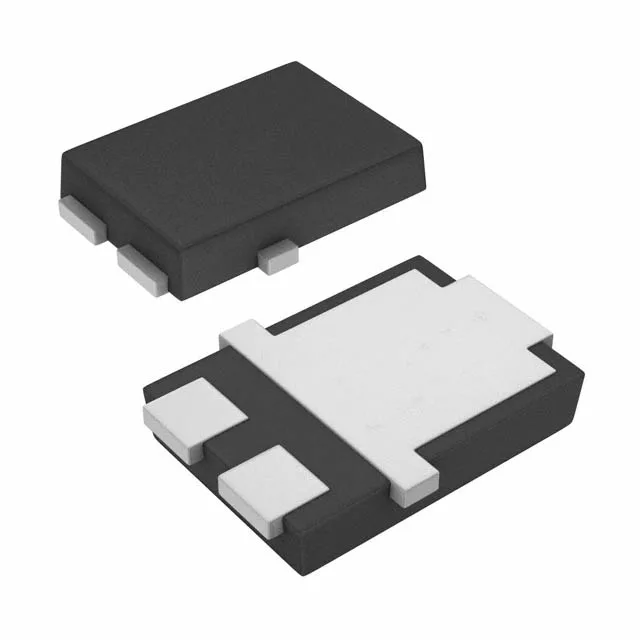
What this Schottky does that a standard rectifier cannot
The STPS630CSFY is a 30 V, 3 A Schottky rectifier in the TO-277A (SMPC) surface-mount package, built on ST's automotive-grade process and qualified to AEC-Q101. Its 450 mV maximum forward voltage at 3 A is roughly half what a PN-junction rectifier of the same current rating would drop, which cuts conduction loss and keeps the junction temperature lower in a tight thermal budget. The fast recovery classification (≤500 ns at >200 mA) means it handles switching frequencies up to the low hundreds of kilohertz without significant reverse-recovery losses — a common requirement in automotive DC-DC converters, alternator rectifier stages, and reverse-battery protection circuits.
At 3 A forward current the Vf max is 450 mV, which sets the conduction loss at 1.35 W. Reverse leakage is 95 µA at 30 V, 25°C junction. Leakage doubles roughly every 10°C rise, so at 125°C junction the leakage can approach several milliamps. In a reverse-polarity protection circuit where the diode is always reverse-biased when the battery is connected correctly, that leakage adds to the quiescent draw — worth checking against the system's sleep-mode budget.
Automotive qualification — what AEC-Q101 means for the BOM
For a Tier-1 supplier or an OEM, this is the gate for PPAP submission — a commercial-grade Schottky would not clear it. The 150°C absolute maximum junction means the designer must derate the forward current above 100°C ambient per the datasheet curve — the 3 A rating is at 25°C case temperature, not at 125°C ambient.