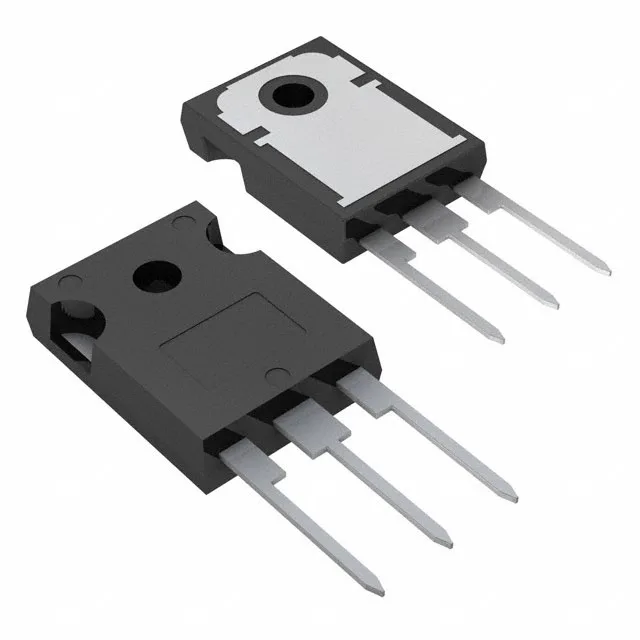
What this Schottky pair does in the power stage
The 920 mV forward drop at 20 A is the figure to plug into your conduction-loss calculation for the heatsink. With a 175°C maximum junction temperature, this part handles the thermal stress of a tightly packed power supply or motor-drive output stage. The TO-247-3 through-hole package bolts directly to a heatsink — no surface-mount reflow profile to worry about, and it is easy to replace in rework.
The 170 V Vr rating places this Schottky in the 120 V to 170 V DC bus range — think power-factor-correction stages, output rectification in 100 V to 120 V AC-input supplies, and freewheeling diodes in motor drives with a 120 V DC link. It is not a 200 V or 250 V part, so do not push it into a 240 V AC rectified bus without margin. The common-cathode configuration means the two anodes share the cathode connection, which is the typical layout for a center-tapped secondary or a half-bridge output — one package replaces two discrete TO-247s and saves board space.
20 A per diode — load budget and derating
Each diode is rated for 20 A average rectified current. In a common-cathode pair, the total package current is 40 A if both diodes conduct equally, but the thermal limit is set by the junction temperature. At 20 A per diode the forward drop is 920 mV, which gives about 18.4 W conduction loss per diode — that is 36.8 W total. The TO-247-3 package with a proper heatsink can handle that, but you need to derate for ambient temperature above 25°C. The 30 µA reverse leakage at 170 V is low for a Schottky at this voltage, so standby losses in a power supply are manageable.
No need to stockpile or hunt for a second source yet — but if you want a cross-reference for dual-sourcing, the common-cathode TO-247 Schottky family from other vendors is worth a look.