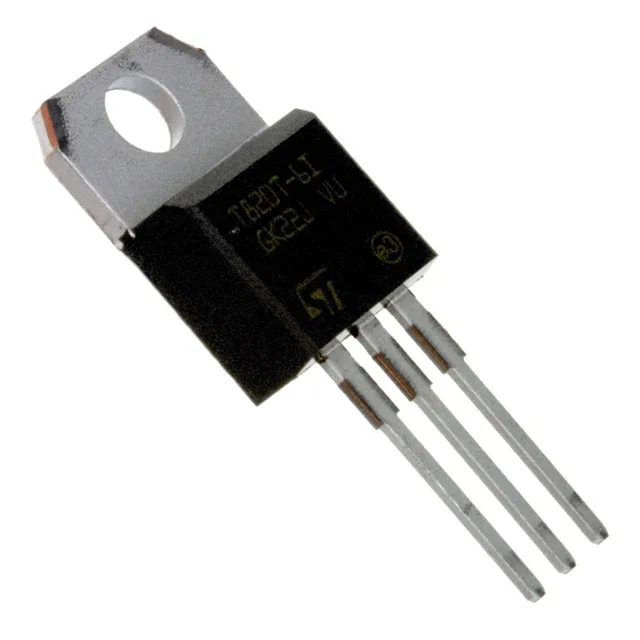
The STPS30M120STN is a 30A, 120V Schottky rectifier from STMicroelectronics, housed in a through-hole TO-220-3 package with narrow leads (TO-220AB). It's rated for fast recovery — ≤500ns at >200mA — which puts it in the class of high-speed switching diodes used in power supplies, not just line-frequency rectification. The 900mV forward drop at 30A is typical for a 120V Schottky at this current level; the 345µA reverse leakage at 120V is a reasonable trade-off for the speed.
This is not a part you can design into a new BOM with confidence of long-term supply; it belongs in a repair, a last-time-buy fulfillment, or a legacy production run where the board is already qualified.
The 30A average rectified current (Io) is the continuous DC rating — it tells you the maximum load current the diode can handle in a typical forward-conduction application. For a 30A output rail, you'd normally derate by 20-30% for reliability, so this part suits a 20-24A continuous load in a well-ventilated design. The 120V reverse voltage (Vr) is the maximum DC blocking voltage; in a 48V or 60V bus, you have ample margin, but in a 100V bus you're at the edge — a 150V or 200V rated part would be safer for transients. The fast recovery spec (≤500ns) is what distinguishes this from a standard 60Hz rectifier: it can switch at tens to low hundreds of kHz without excessive reverse-recovery losses, making it suitable for the secondary side of a forward converter or flyback supply. The 900mV forward drop at 30A is the conduction loss figure — at 30A, that's 27W of dissipation, which demands a heatsink with good thermal management, especially given the 150°C maximum junction temperature.
Package and mounting — TO-220 through-hole
The narrow-lead variant (TO-220AB Narrow Leads) fits standard TO-220 footprints but has slightly thinner leads — check your PCB hole diameter if you're replacing a standard TO-220. It ships in tube, which is typical for through-hole power devices. Hand-soldering is straightforward: the tab can be soldered to a copper pad on the board or bolted to a separate heatsink. For a 30A part, a heatsink is mandatory unless the duty cycle is very low.