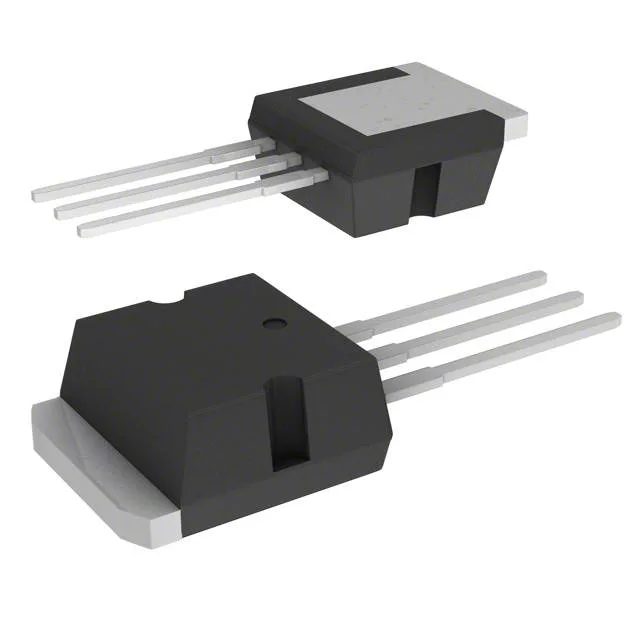
Dual Schottky in a through-hole tabbed package
It comes in the I2PAK through-hole package (TO-262AA), which gives you a metal tab for bolting to a heatsink and longer leads than a standard TO-220 — useful when you need extra creepage distance on a high-voltage rail. The forward drop is specified at 880 mV maximum when each diode is carrying 15 A, so conduction losses are predictable in a 30 A total-output design.
120 V blocking and 15 A per leg — sizing the rectifier stage
The 120 V reverse voltage rating sets the maximum DC bus voltage this Schottky can block. In a typical 48 V or 60 V output power supply, you get healthy derating margin. The 15 A per-diode average rating means the pair can handle a combined 30 A in a center-tapped or full-wave configuration, but the thermal limit in the I2PAK will be the real constraint — the junction is rated for 150°C maximum, so you need to size the heatsink for the sum of the forward losses at your operating current. At 15 A per diode the 880 mV Vf produces about 13.2 W per die, which is a lot of heat to pull through a through-hole tab.
Schottky switching — no stored charge to manage
This is a Schottky diode, so reverse recovery is negligible — the <500 ns speed classification is really a formality; a Schottky's majority-carrier action means it turns off with almost no stored charge. The 200 µA reverse leakage at 120 V is typical for a 120 V Schottky at temperature; expect it to rise significantly at the 150°C junction limit, so derate the blocking voltage if the heatsink runs hot.
Active status — no LTB pressure
If you are qualifying this for a new design, you can expect standard lead times and no forced redesign horizon from obsolescence.