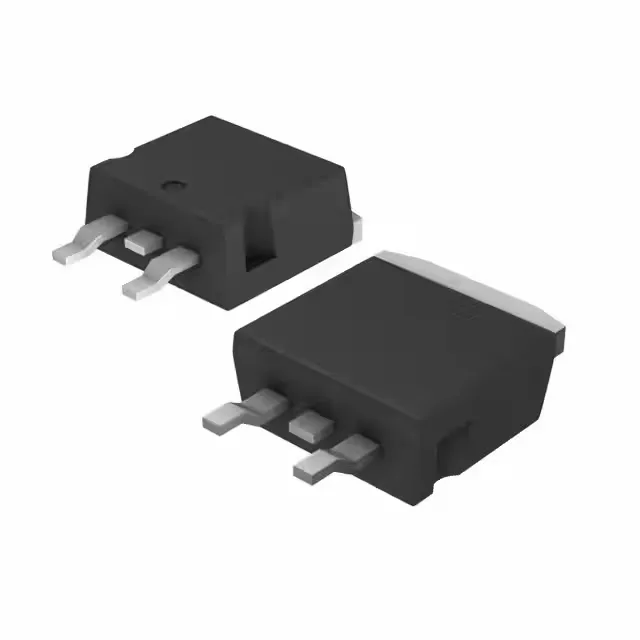
Dual Schottky in a single D²PAK footprint
The STPS30150CG-TR pairs two 150 V Schottky rectifier diodes in a common-cathode configuration, each rated for 15 A average rectified current. The 920 mV forward voltage at 15 A per diode is typical for a 150 V Schottky — the higher reverse-blocking voltage trades a bit of Vf for the margin needed in 48 V to 72 V rails where transients can crest well above the nominal bus. The D²PAK (TO-263-3) package with exposed tab handles the thermal load: 15 A per diode at 920 mV generates about 14 W total conduction loss at full tilt, and the 175°C maximum junction temperature gives headroom for that dissipation in forced-air or well-ventilated enclosures.
What the forward voltage and leakage mean on your bench
At 15 A and 25°C junction, the 920 mV Vf is the conduction-loss floor. That figure climbs with temperature — at 125°C junction you can expect roughly 0.8× the 25°C value, so the actual dissipation in a hot power supply is lower than the cold number suggests. The reverse leakage at 150 V is 6.5 µA typical at 25°C, but Schottky leakage doubles every 10°C; at 125°C junction the leakage current can approach a few milliamps, which matters for standby-power budgets in always-on equipment. This makes the part suitable for the output rectification stage of a 100–200 kHz switching supply where the switching edge is the main loss mechanism.
Common-cathode topology choices
The common-cathode pair is the natural fit for a center-tapped secondary winding in a full-wave rectifier — the two anodes connect to each half of the winding, and the common cathode becomes the positive output rail. It also works as a dual OR-ing diode in redundant power feeds: each anode connects to a separate supply, and the common cathode delivers the higher of the two voltages to the load. If your design needs a series pair (two diodes in one package, anodes separate, cathodes separate) or an independent pair, the STPS30150CG-TR is not that part — the common-cathode tie is fixed on the die. The base number STPS30150 covers the family; the suffix letter after the dash indicates the configuration variant.
Active production and compliance status
ROHS3 compliance is confirmed, so it passes the current EU restriction directive without exemption claims.