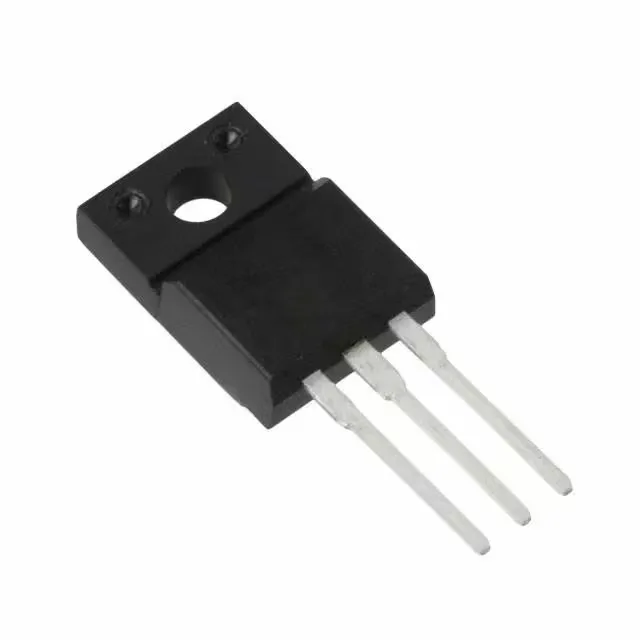
Dual Schottky in a common-cathode pair — what it does
The STPS15SM80CFP is a dual Schottky rectifier from STMicroelectronics, configured as a 1 Pair Common Cathode in a single TO-220AB Full-Pak through-hole package.
175°C junction — why it matters for the thermal budget
The maximum junction temperature of 175°C is a solid margin for power-supply designs that run hot — think enclosed PSUs, motor drives, or any board where airflow is restricted. With a 7.5 A per-diode load and 780 mV Vf, each diode dissipates roughly 5.85 W at full current. The TO-220AB Full-Pak (fully isolated tab) simplifies heatsinking without an insulating pad, but the thermal resistance through the plastic tab is higher than a standard TO-220 — so that 175°C ceiling is what keeps you from derating too aggressively. If your ambient is 85°C, you have about 90°C of headroom to the junction limit; a quick thermal calculation against the package's RthJA (not listed here, but typical for Full-Pak is around 60–70°C/W) will tell you whether you need forced air or a larger heatsink.
STMicroelectronics lists the STPS15SM80CFP as Obsolete. If you are qualifying a replacement, the common-cathode dual-Schottky space at 80 V / 7.5 A per diode has several active alternatives from ST and other vendors — but pin compatibility and footprint need checking against the TO-220AB Full-Pak mechanical outline.
Reverse leakage at 80 V — the catch with Schottkys
Reverse leakage is specified at 20 µA at 80 V reverse voltage. That is typical for a Schottky at its rated blocking voltage — the trade-off for the low forward drop. At elevated junction temperatures, Schottky leakage rises exponentially; at 125°C junction, expect that 20 µA to be several milliamps. If your circuit idles at high temperature with the diode reverse-biased (e.g., OR-ing diode in a redundant supply), budget for that leakage in your quiescent-current calculation. It is not a problem for most switching supplies, but it rules out this part for any ultra-low-standby-power design where the diode sits reverse-biased for long periods.