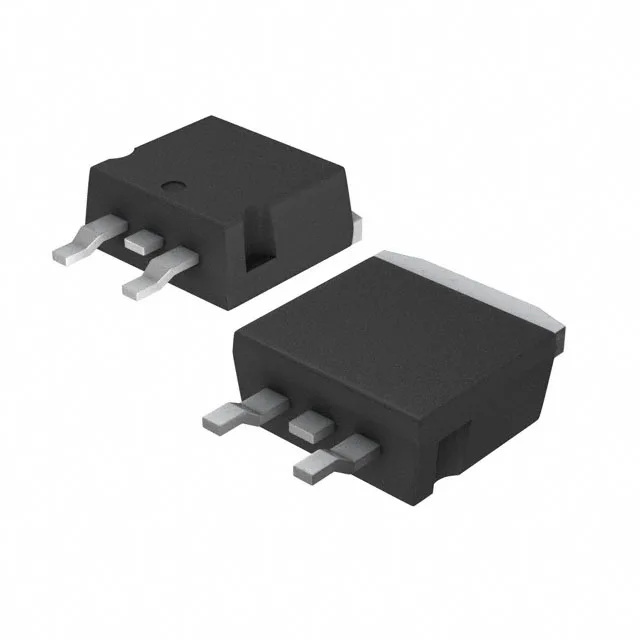
Automotive Schottky in a D²PAK — what the ratings tell you
It pairs two Schottky diodes in a common-cathode configuration inside a single D²PAK (TO-263) surface-mount package. This combination of ratings — 45 V blocking, 7.5 A per leg, 175°C junction — targets 12 V and 24 V automotive power-train and body-electronics applications where OR-ing, reverse-polarity protection, or center-tapped secondary rectification is needed.
Common-cathode dual — board-area and thermal advantage
The 1-pair common-cathode arrangement lets you handle two independent rectification paths in one package, cutting PCB area and placement cost versus two discrete Schottkys. In a center-tapped full-wave rectifier the common cathode becomes the positive output rail; in an OR-ing configuration each anode connects to a separate supply, with the shared cathode feeding the load.
The 45 V maximum reverse voltage covers 12 V and 24 V automotive rails with healthy margin — a 24 V nominal bus sees transients up to 36 V, which this part absorbs. It does not suit a 48 V nominal system (typical telecom or mild-hybrid traction battery), where the steady-state bus sits above 50 V. The reverse leakage is specified at 100 µA at 45 V, typical for a Schottky of this voltage class; expect leakage to double or triple near the 175°C junction limit, so factor that into the quiescent budget if the diode is always reverse-biased.
Active lifecycle — no LTB concern for new designs
STMicroelectronics lists the STPS1545CGY-TR as Active. The base product number STPS1545 has been in production for years across multiple package variants, so the die and assembly line are mature. For a BOM that needs automotive-grade Schottkys, this part carries no imminent obsolescence risk.