That voltage rating puts it squarely in offline power-conversion territory — flyback primary switches, PFC boost stages, and 400 VDC bus rails in motor drives or inverters. The 14 A continuous rating is the thermal ceiling with the case held at 25°C; in a real 70°C ambient with a modest heatsink, you'll derate to roughly 9–10 A before the junction hits 150°C.
340 mOhm on-resistance and 106 nC gate charge — the switching trade-off
For a 500 V device in a TO-220, that's a reasonable conduction-loss figure — at 7 A you're looking at about 17 W dissipation in the channel alone. The 106 nC total gate charge at 10 V tells you the driver side: a standard gate-driver IC delivering 1 A peak can charge the gate in roughly 100 ns, so switching frequencies up to 100 kHz are practical without excessive cross-conduction.
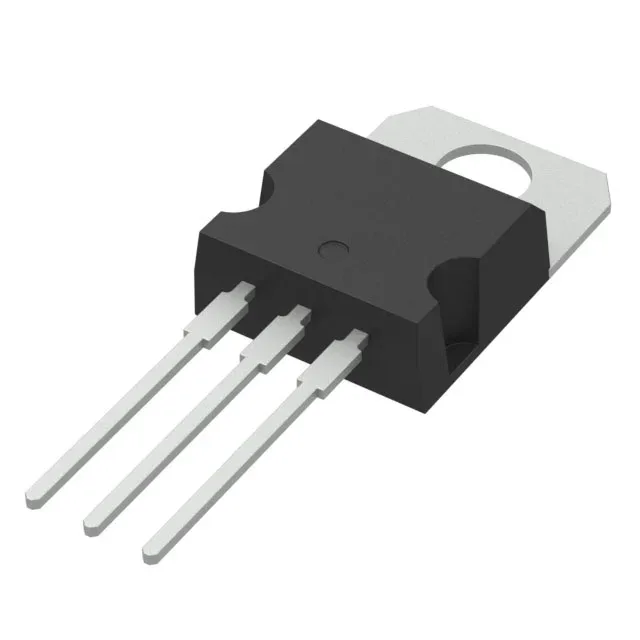
TO-220 package — the through-hole workhorse
The TO-220-3 through-hole package is the standard for this power level. The tab is the drain; the centre pin is drain as well, with gate and source on the outer pins. The 160 W maximum power dissipation assumes the tab is bolted to an infinite heatsink — in practice, a clip-on or screw-mounted heatsink with thermal compound is expected. The -50°C to 150°C junction range covers cold-start and outdoor enclosures without a low-temperature derating penalty.