Dual asymmetric cores: application + real-time on one die
The STM32MP157CAA3 pairs an ARM Cortex-A7 running at 650 MHz with a Cortex-M4 coprocessor at 209 MHz — two cores that share the same memory map but serve different scheduling domains. The A7 handles Linux or Android application stacks; the M4 runs bare-metal or RTOS code for deterministic control loops, sensor fusion, or protocol offload without jitter from the OS scheduler. This asymmetric architecture means a single BOM replaces what used to require a separate application processor and a microcontroller, saving board space and eliminating inter-chip communication latency across a UART or SPI link.
Memory controller and DRAM flexibility
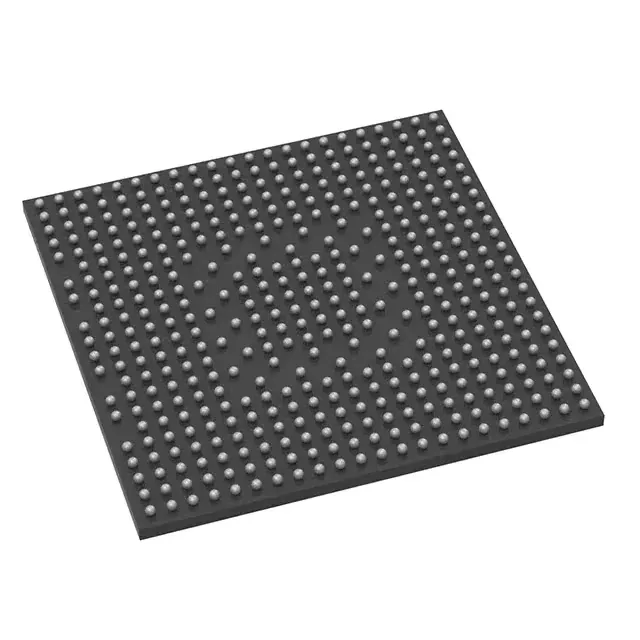
The integrated RAM controller supports DDR3, DDR3L, LPDDR2, and LPDDR3 — four DRAM families from a single memory bus. This lets the system architect choose between cost-optimised DDR3, low-voltage DDR3L for power-sensitive designs, or LPDDR2/3 for mobile-derived modules where package-on-package stacking is preferred. The 448-LFBGA (18x18 mm) package routes the DDR signals to specific ball positions; the layout must match the DRAM vendor's recommended fan-out pattern to keep signal integrity within the JEDEC timing budget at 650 MHz core speed.
Industrial temperature range and active lifecycle
The 125°C ceiling is the absolute max ambient — the actual junction temperature depends on the power dissipation in the core and the thermal resistance of the 18x18 mm BGA to the PCB copper plane.
Connectivity and peripheral integration
Five USB 2.0 interfaces are available: two host-only ports and three OTG+ PHY ports that can act as host, device, or dual-role. The integrated PHYs eliminate external USB transceivers for most designs — only the connector, ESD protection, and common-mode choke are needed on the board. Dual Ethernet MACs support 10/100 Mbps and Gigabit Ethernet respectively, enabling the MPU to serve as a protocol gateway between a legacy 100BASE-TX fieldbus and a Gigabit backbone without an external switch IC.
Security and display subsystem
ARM TrustZone (TZ) provides hardware-enforced isolation between a secure world and a normal world — the secure boot ROM, crypto accelerators, and secure memory regions are inaccessible to code running in the non-secure domain. This meets the baseline for secure firmware update, key storage, and tamper detection in payment terminals and access control panels. The display subsystem includes an LCD controller and HDMI-CEC interface, with hardware graphics acceleration for 2D composition and rotation — sufficient for a 7-inch industrial HMI running at 60 fps without burdening the Cortex-A7.