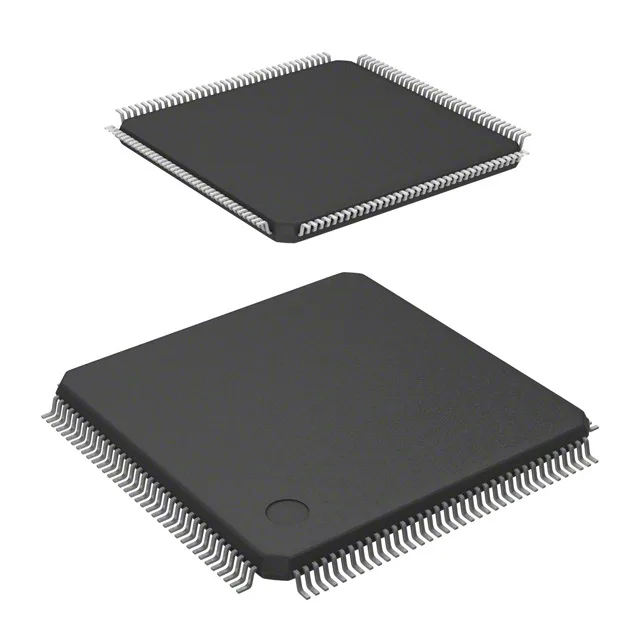
What this STM32L4R5ZIT6P brings to the BOM
The 120 MHz core speed puts this well above the 32 MHz of the STM32L1 series (e.g., STM32L151CBU6A). That roughly 4× clock advantage translates to tighter loop times for sensor fusion, real-time control, or graphics rendering. The Cortex-M4 includes a single-cycle multiply and a hardware FPU, so floating-point math doesn't stall the pipeline. If your firmware does FFTs, IIR filters, or PID loops, this core saves you from offloading to a separate DSP.
2 MB of Flash is enough for a full-featured RTOS, a graphics stack (e.g., TouchGFX or LVGL), and a large application image with room for OTA staging. The 640 KB RAM supports multiple frame buffers at QVGA resolution, deep packet buffers for USB or Ethernet, or complex data structures without external SRAM. No need to add a serial Flash or PSRAM for most designs — the on-chip memory covers it.
Temperature range and supply — fitting the environment
If your design needs to survive cold-crank or brownout conditions, the built-in brown-out detect and POR keep the core from corrupting Flash or RAM.
Package and footprint — 144-LQFP
The 144-LQFP (20x20 mm) is a common fine-pitch QFP with 0.5 mm lead pitch.
It's ROHS3 compliant. No last-time-buy risk for the foreseeable future.