What the 80 MHz Cortex-M4 and 1 MB Flash mean for your BOM
The STM32L496ZGT6P is an STMicroelectronics 32-bit MCU built around an ARM Cortex-M4 core clocked at 80 MHz, with 1 MB of Flash and 320 KB of SRAM on a single die. This is the high-density member of the STM32L4 ultra-low-power series, designed for applications that need both compute throughput and energy efficiency — think battery-operated industrial sensors, portable medical devices, and field instruments that run on a coin cell or a single Li-ion cell down to 1.71 V. The 80 MHz core with DSP instructions and a single-precision FPU handles real-time filtering and control loops without an external coprocessor. The 1 MB Flash is large enough for a full protocol stack plus application code, while the 320 KB SRAM leaves room for data buffering — for example, a CANopen node logging sensor data over USB OTG can keep several seconds of trace in RAM without external memory.
Package and supply — what fits on the board
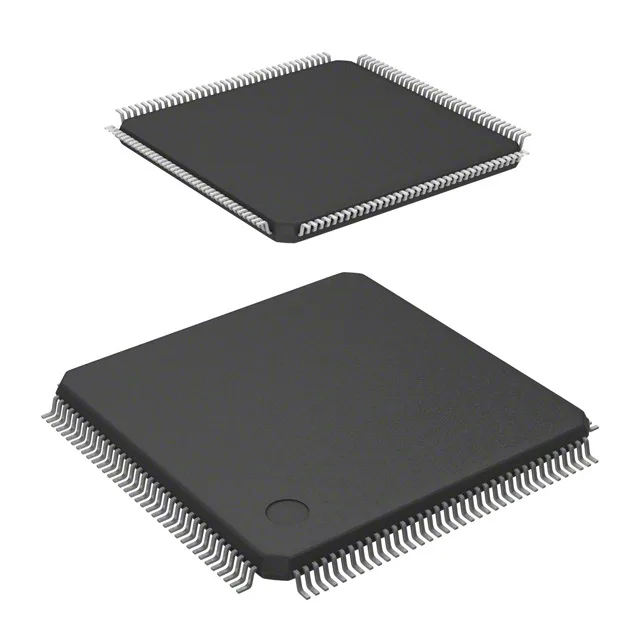
Housed in a 144-LQFP with a 20x20 mm body, this part offers 115 general-purpose I/Os. That many I/Os in a QFP means a four-layer board is usually enough to route the parallel display or external memory bus without resorting to a BGA. It is not AEC-Q100 listed, so it is not the pick for under-hood automotive, but the temperature range covers most commercial and industrial environments.
Connectivity and peripherals — what hooks up without extra chips
The STM32L496ZGT6P integrates a CANbus controller, USB OTG (host and device), a Quad-SPI interface for external Flash, and a serial audio interface (SAI) for I2S codecs. The LCD controller drives segment displays directly, which saves a display driver IC in metering and panel applications.
How it compares to the STM32L151CBU6A
The STM32L151CBU6A is a lower-tier sibling in the STM32L1 series with a Cortex-M3 core at 32 MHz, 128 KB Flash, and 37 I/Os in a smaller package. The STM32L496ZGT6P more than doubles the core speed (80 MHz vs 32 MHz), offers 8x the Flash (1 MB vs 128 KB), and provides 115 I/Os versus 37. If your application needs USB OTG, a parallel memory bus, or a display controller, the L496 is the part that supports them; the L151 lacks those peripherals.