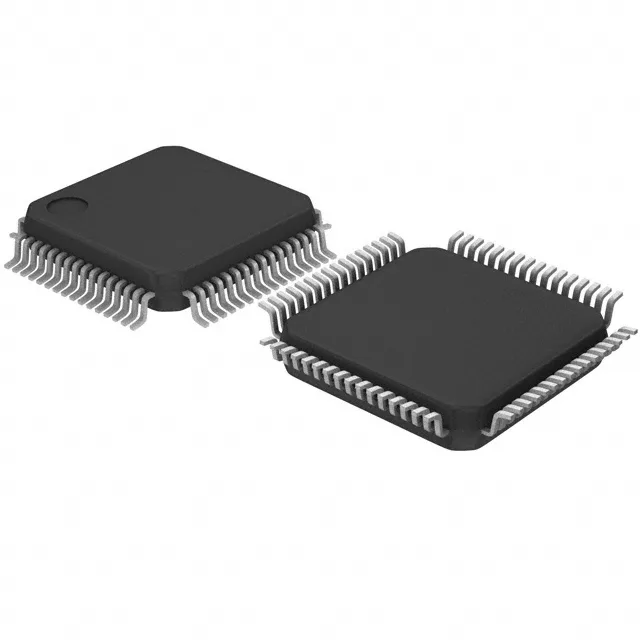
80 MHz Cortex-M4 with 1 MB Flash — the sweet spot for power-constrained processing
It targets applications where a balance of processing throughput and energy efficiency is critical — think battery-operated sensor hubs, portable medical devices, industrial data loggers, and IoT edge nodes that must run real-time control loops while keeping the average current draw in the microamp range. The Cortex-M4 includes a single-precision FPU and DSP instructions, so floating-point sensor fusion or FFT workloads run without a software math library penalty.
Connectivity and peripheral set — CAN, USB OTG, QSPI, and more
This MCU integrates a broad peripheral set that reduces the need for external interface chips. On the connectivity side, it includes CANbus for industrial automation, USB OTG for dual-role device/host operation, QSPI for high-speed serial Flash or RAM expansion, and SAI for audio codec interfacing. The 12-bit ADC has 16 channels, and there are two 12-bit DAC outputs. Brown-out detect, DMA, LCD drive, and PWM are built in. With 52 general-purpose I/Os in the 64-LQFP package, most designs will have headroom for local sensors, displays, and control signals without needing a port expander.
For dual-sourcing or supply resilience, note that the STM32L1 series (e.g., STM32L151CBU6A) is a different core (Cortex-M3 at 32 MHz) and lower memory tier — not a pin-compatible drop-in, but a functional alternative for less demanding applications.