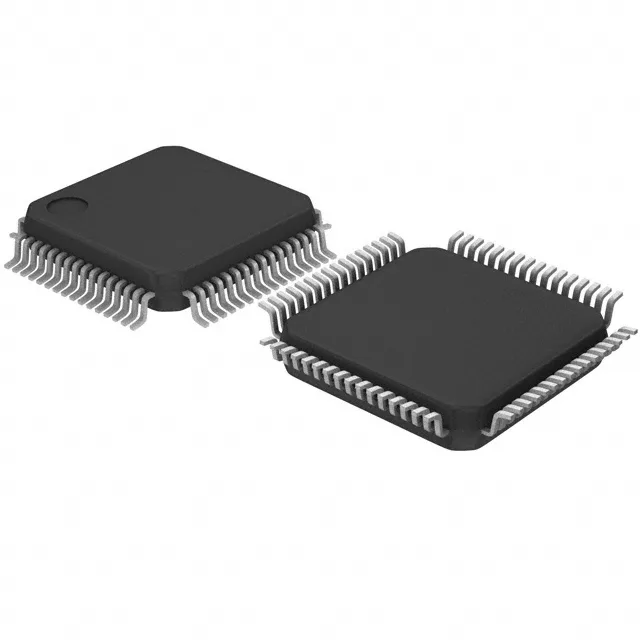
What this STM32L476RCT6TR brings to the board
The 80 MHz core includes a single-precision floating-point unit, so you can run PID loops, FFTs, or motor-control observers without software emulation. That saves Flash and cycles compared to a fixed-point-only core at the same speed. The STM32L4 architecture also has a zero-wait-state Flash accelerator for most of the 80 MHz range, but if you push the system clock past 72 MHz you may need to insert one wait state — check the Flash latency configuration in the reference manual during bring-up.
Peripheral set for fieldbus and human-machine interface
This part carries CANbus for industrial networks, USB OTG for direct connection to a host or a thumb drive, and QSPI for glueless external Flash or RAM expansion. The LCD controller can drive a small segment display directly, which is handy for a local readout on a pump or a panel meter. With 51 GPIOs in the 64-pin package, you have enough I/O for a parallel display bus plus a handful of sensors and actuators.
Power supply and temperature range for real-world environments
Brown-out detection and a programmable voltage detector are built in, so you can reset cleanly on a sagging supply without an external supervisor.
The 64-LQFP (10x10 mm) has a 0.5 mm pitch — doable with a fine chisel tip and flux, but you want a steady hand and magnification. No exposed pad underneath, so you do not need a hot-air station to remove it; side-cut the leads and clean up each pad individually. The TR suffix means it ships on Tape & Reel, which is the standard for pick-and-place; if you are ordering a handful for prototyping, expect a cut-tape or partial reel.
STMicroelectronics lists the STM32L476RCT6TR as Active. The base product number is STM32L476, meaning the entire STM32L476 family shares the same die and peripheral map — the suffix differences are package and temperature grade.