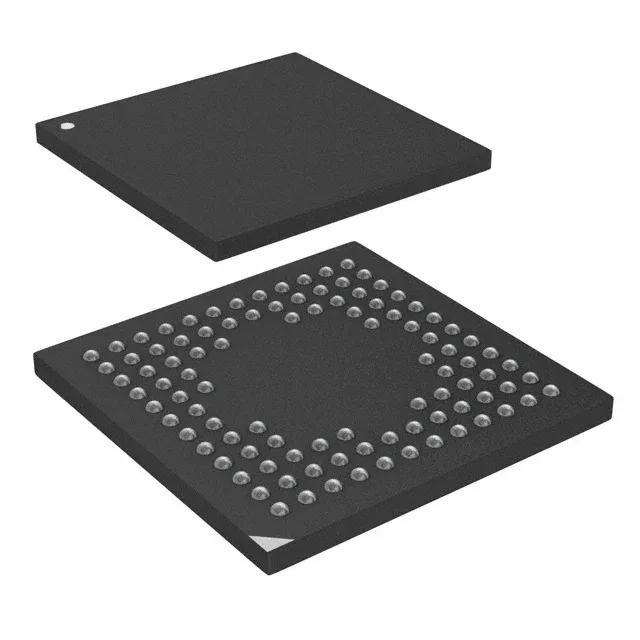
What this STM32L462VEI6 brings to a low-power design
With 83 I/O lines and a rich peripheral set including CAN, USB, multiple SPI/I²C, and a 12-bit ADC with 16 channels, this part targets battery-powered instrumentation, portable medical devices, and industrial sensor nodes that need both compute throughput and sub-µA standby current.
The 80 MHz core speed is the headline performance spec for this STM32L4 part. Compared to the earlier STM32L1 series (which tops out at 32 MHz on a Cortex-M3), the L462 runs at 2.5× the clock rate. That matters when you are doing on-the-fly DSP math — sensor calibration, digital filtering, or audio processing — without waking a separate coprocessor. The FPU handles single-precision floating-point in hardware, so a PID loop or FFT step finishes in a few dozen cycles instead of a software-emulated hundred-plus. For a battery-powered design, the trade-off is that running at 80 MHz draws more active current than a lower-clock part; the L4 family compensates with multiple low-power modes (sleep, stop, standby) that drop consumption to the microamp range when the CPU is idle.
Memory sizing: 512 KB Flash / 160 KB SRAM
The 160 KB SRAM gives headroom for multiple DMA buffers, a TCP/IP stack's packet pool, and a display frame buffer at QVGA resolution. If your application needs more than 512 KB of code space, you step up to the STM32L4+ series with 1 MB or 2 MB Flash; if you need less, the STM32L4 value-line parts trim Flash to 256 KB or 128 KB. The 160 KB SRAM is split across multiple banks, which lets you keep one bank in retention during stop mode while the rest is powered down — a useful trick for saving the last sensor reading across a deep-sleep cycle.
Package and layout: 100-UFBGA (7x7)
The 100-UFBGA package measures 7 mm × 7 mm with a 0.5 mm ball pitch. The small footprint is a win for space-constrained designs like a sensor module or a wearable, but it demands careful decoupling — place a 100 nF capacitor within 2 mm of each VDD/VSS pair, and a 4.7 µF bulk cap near the main supply entry. The package is MSL 3, so if the moisture-barrier bag has been open longer than the floor-life window, bake the parts at 125°C for 24 hours before reflow. Reballing a 0.5 mm pitch BGA in rework is possible with a stencil and a hot-air station, but the success rate drops if the board has been through multiple reflow cycles.
The ROHS3 compliance is confirmed. There is no official second-source alternate; the STM32L1 series (e.g., STM32L151CBU6A) is a different core (Cortex-M3 at 32 MHz) and a different package, so it is not a pin-compatible drop-in.