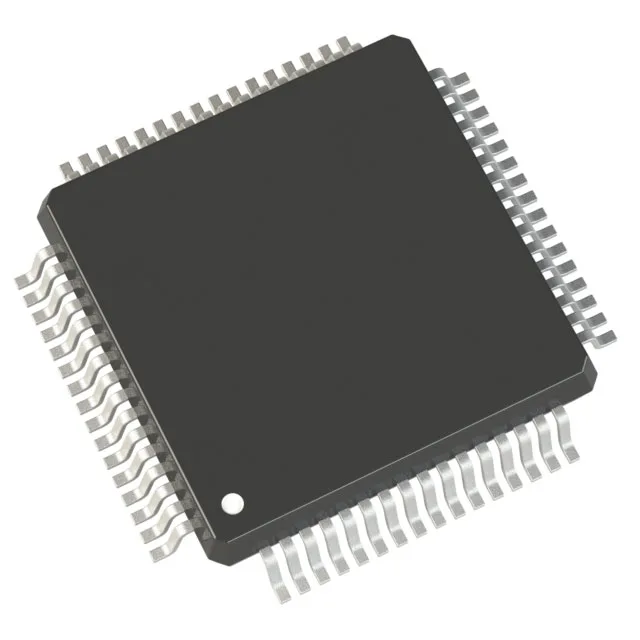
The flash wait state needs to be set to 1 above roughly 48 MHz, but the ART Accelerator on the STM32L4 series keeps most instruction fetches single-cycle from the 256 KB Flash. For the BOM line, this is the tier that balances active power draw against compute — the STM32L4 is built for low-power operation, so 80 MHz is the performance ceiling when you need it, not the continuous operating point.
Memory budget: 256 KB Flash, 64 KB RAM
256 KB of program Flash and 64 KB of SRAM (organized as 64K x 8) is the mid-density option in the STM32L4 family. This is enough for a FreeRTOS-based application with a TCP/IP stack, a USB device stack, and a modest data logger. If the firmware image plus a 50% headroom margin fits in 256 KB, this part saves the cost of stepping up to the 512 KB or 1 MB variants. The 64 KB RAM includes a 4 KB backup SRAM that survives the lowest stop modes, useful for retaining calibration data or fault logs across a deep-sleep cycle.
Connectivity and peripheral set for system integration
The 52 I/O pins in the 64-LQFP package leave enough GPIO for a local display or keypad alongside the serial buses. For a motor drive or industrial gateway, the CAN and QSPI interfaces reduce the need for external bridge ICs.